About Semiaquilegia adoxoides (DC.) Makino
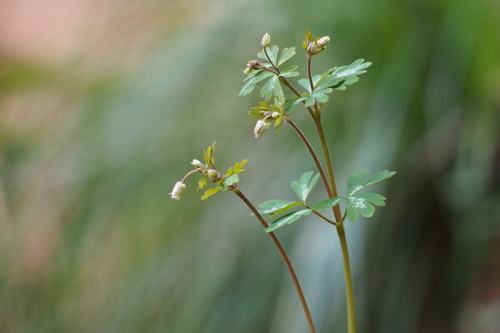
Semiaquilegia adoxoides (DC.) Makino is a perennial herb that belongs to the genus Semiaquilegia of the family Ranunculaceae. It produces tuberous roots ranging from 1 cm (0.39 in) to 2 cm (0.79 in) long, and 3 mm (0.12 in) to 6 mm (0.24 in) in diameter. This species flowers during March and April. Its flowers have a diameter between 4 mm (0.16 in) and 6 mm (0.24 in), and grow from inflorescences via pubescent pedicels that measure 1 cm (0.39 in) to 2.5 cm (0.98 in) long. Each flower has five petaloid sepals, which are typically white with purple tints. The sepals are 4 mm (0.16 in) to 6 mm (0.24 in) long and 1.2 mm (0.047 in) to 2.5 mm (0.098 in) wide. Each flower also has five spatulate petals. All species in the genus Semiaquilegia are hermaphroditic. Fruiting in Semiaquilegia adoxoides happens during April and May. Plants in this genus produce seeds inside divergent follicles. The seeds are densely wrinkled (rugose), range in color from brown to black-brown, and measure approximately 1 mm (0.039 in) long. Semiaquilegia adoxoides is native to central and southeastern China, Korea, and Japan, and has an introduced population established on Taiwan. In 1946, Munz observed that this species, which he classified as an Isopyrum, was sometimes sold by nurseries for cultivation in the United States. At the time, these plants were incorrectly labeled as Aquilegia ecalcarata.