About Selenotoca multifasciata (Richardson, 1846)
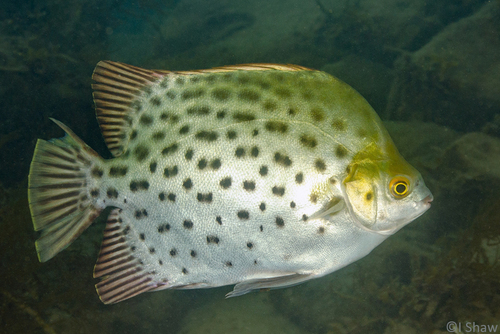
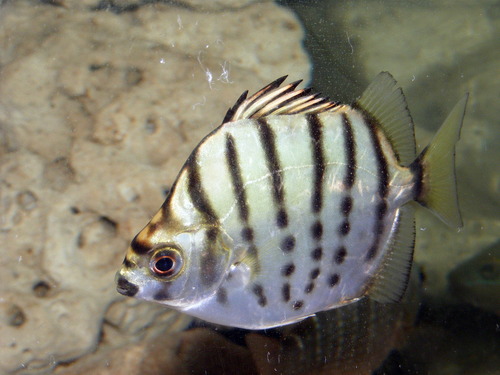
Spotbanded scat, Selenotoca multifasciata (Richardson, 1846), has a deep, compressed body covered in very small ctenoid scales. The head has a steep dorsal profile and a moderately large eye, whose diameter is noticeably shorter than the length of the rounded snout. The small, horizontal mouth is not protractile, and the jaws hold several rows of bristle-like teeth. The dorsal fin has 7–12 spines and 16 soft rays, while the anal fin has 4 spines and 15–16 soft rays. The first spine of the dorsal fin lies flat, and there is a deep incision between the spiny and soft-rayed sections of the dorsal fin. Juveniles have a rounded caudal fin, which becomes truncate in adults. The rear margins of the soft-rayed portions of the dorsal and anal fins are angled diagonally. This species reaches a maximum total length of 40 cm (16 in). Its base body color is greenish or silvery, with many dark vertical bars along the upper flanks, and dark spots smaller than the eye arranged in roughly vertical rows on the lower flanks. The lips are black. The rear margins of the caudal fin and the soft-rayed portions of the anal and dorsal fins have a thin black edge, which fades completely in individuals with a standard length longer than 6 cm (2.4 in). The spotbanded scat is distributed across Sulawesi and Papua in eastern Indonesia, Papua New Guinea, New Caledonia, and northern and eastern Australia. In Australia, its range extends from Shark Bay in Western Australia along the northern coasts to Sydney in New South Wales. It inhabits brackish mangrove estuaries and coastal freshwater.