About Selenidera spectabilis Cassin, 1858
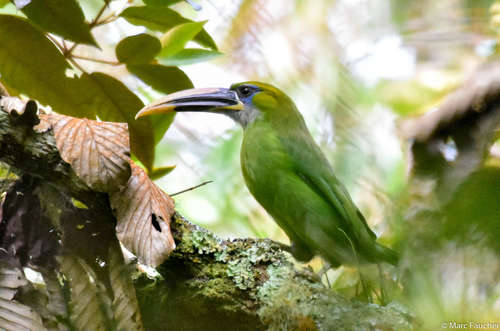
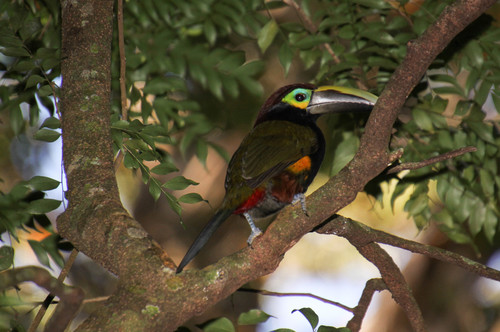
The yellow-eared toucanet (Selenidera spectabilis Cassin, 1858) is 36 to 38 cm (14 to 15 in) long and weighs 175 to 245 g (6.2 to 8.6 oz). It is the largest and most distinctively plumaged member of its genus Selenidera. Males and females share the same bill pattern, but the female’s bill is shorter. The bill has a vertical black line at its base. The maxilla is yellow with an olive brown triangle below it that narrows from the base, and the tomium has horn-colored tips. The mandible ranges from dark olive to brownish black. Adult males have a black cap that extends down the hindneck, blue to green bare skin around the eye, and a large yellow tuft that extends back behind the eye. Their back and uppertail coverts are green, and their tail is blackish. Their plumage is black from the chin to the belly, with a yellow patch on the flank, chestnut thighs, and red undertail coverts. Adult females have a chestnut forehead and hindneck, and do not have the male’s yellow ear tuft. Immature yellow-eared toucanets are duller in color than adults, and their bill pattern is less distinct. The black plumage of immature males is sooty, and the chestnut plumage of immature females is brownish. The yellow-eared toucanet is distributed from northeastern Honduras south through Nicaragua, Costa Rica, Panama, and western Colombia, reaching into extreme northwestern Ecuador. It lives in wet forested slopes and ridges, nearby secondary forest, and fruit trees close to the forest edge. In terms of elevation, it mostly occurs between 300 and 1,100 m (980 and 3,600 ft), but can be found as low as sea level. It also occurs as high as about 1,500 m (4,900 ft), but no individuals have been recorded above 500 m (1,600 ft) in Honduras.