About Selenidera reinwardtii (Wagler, 1827)
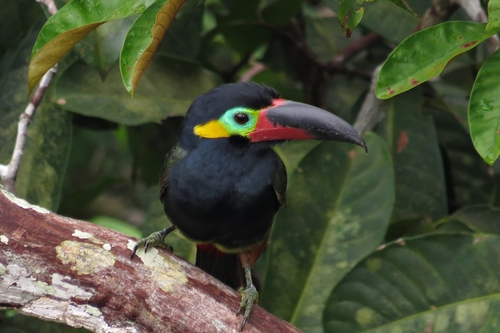
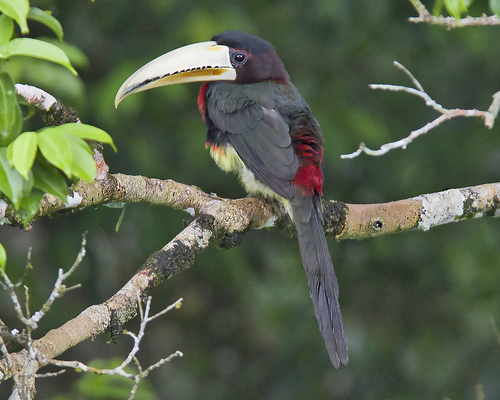
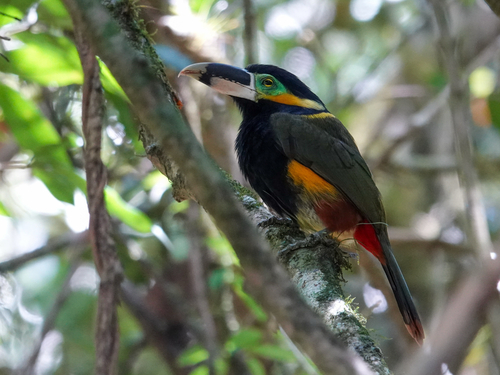
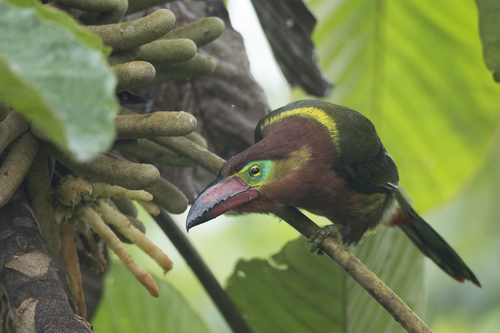
The golden-collared toucanet (Selenidera reinwardtii, first described by Wagler in 1827) measures 33 to 35 cm (13 to 14 in) in total length. The nominate subspecies weighs 129 to 178 g (4.6 to 6.3 oz), while the S. r. langsdorffii subspecies weighs 134 to 200 g (4.7 to 7.1 oz). The two subspecies have nearly identical plumage. Adult males have black plumage on the head, nape, and shoulders. A narrow yellow band separates the black shoulders from the green back. Their tail is green, with chestnut tips on the central two or three pairs of feathers. The eye is surrounded by bare blue skin, which is greener in S. r. langsdorffii, and a golden-yellow tuft of feathers extends out behind the eye. Most of their underparts are black, with gold-yellow flanks that are more orange in S. r. langsdorffii, and red undertail coverts. Adult females have chestnut plumage in the areas where males have black; their facial tuft and flanks are duller, and the yellow band on the back is narrower. Immature golden-collared toucanets are duller overall, with rusty undertail coverts. The two subspecies of golden-collared toucanet have different bill patterns; within each subspecies, males and females share the same bill pattern, though the female's bill is shorter. The nominate subspecies' bill has a vertical black line at its base and a black culmen. Most of the bill is red, with approximately the outer third colored black. The maxilla has black to ivory 'teeth' along the tomium. S. r. langsdorffii's bill has a mostly black maxilla with a green base, and a mandible that is roughly half green and half black. Occasionally, this subspecies' bill is almost entirely black. Its tomial 'teeth' are creamy to whitish in color. The nominate subspecies of golden-collared toucanet ranges from south-central and southeastern Colombia, near the Brazilian border, south through eastern Ecuador into north-central and northeastern Peru. S. r. langsdorffii is found from north-central and northeastern Peru and western Brazil, south into northwestern Bolivia. This species lives in the interior and edges of montane forest, floodplain forest, and occasionally várzea. It prefers drier uplands and avoids secondary forest. In most of its range, it most commonly occurs at elevations up to around 1,000 m (3,300 ft), but it can occasionally be found at higher elevations: up to 1,200 m (3,900 ft) in Ecuador, 1,500 m (4,900 ft) in Peru, and 1,300 m (4,300 ft) in Bolivia.