About Selene vomer (Linnaeus, 1758)
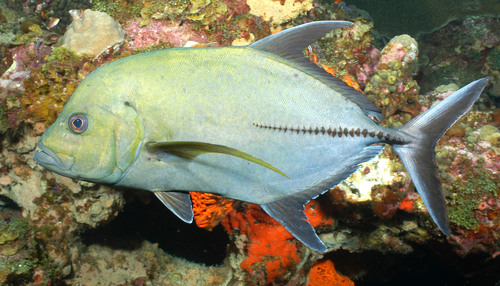
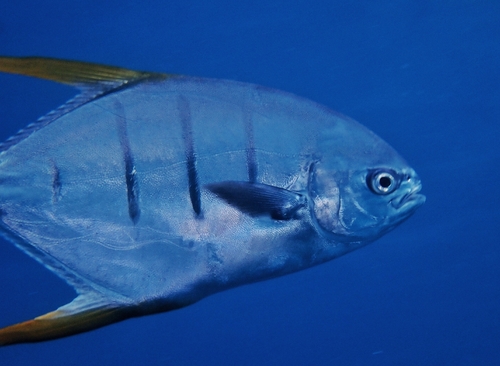
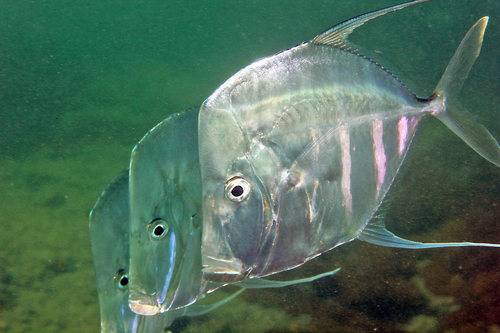
The lookdown (Selene vomer) is similar to the Atlantic moonfish, but can be distinguished by its dorsal and anal fins: the second ray on each fin is many times longer than the surrounding rays, which gives these fins a noticeably scythe-like shape. The lookdown's dorsal fin has 9 spines and 23 rays, while its anal fin has 3 spines and 18 rays. Like the Atlantic moonfish, it has a deep, rhombus-shaped, laterally-compressed body. On its head, the mouth is set low and the eyes are set high, and the overall head profile is concave. Its caudal fin is forked, just like in pompanos, while the pectoral fin is scythe-shaped and reaches the middle of the second dorsal fin. The lookdown is silvery on both sides, with a darker tinge along its upper body. Young lookdowns have several faint vertical bars that fade as the fish grows. The longest scientifically recorded lookdown measured 48.3 cm (19.0 in) in length, and the heaviest recorded individual weighed 2.1 kilograms (4.6 lb).
In terms of distribution and habitat, the lookdown occurs in the western Atlantic Ocean, ranging from Canada and Maine south to Uruguay, including Bermuda and the Gulf of Mexico. While it is common in tropical Atlantic waters, it is only rarely sighted in the Greater Antilles. It inhabits marine and brackish waters at depths between 1 and 53 meters (3.3 to 170 ft), and lives in shallow coastal waters over hard or sandy bottoms. Juvenile lookdowns may be found in estuaries or near sandy beaches. Lookdowns often form large shoals, but they may also split off into smaller groups or swim in pairs.