About Selasphorus sasin (R.Lesson, 1829)
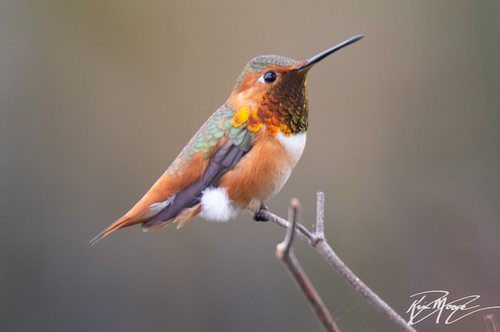
Allen's hummingbird, scientifically named Selasphorus sasin (R.Lesson, 1829), is a small bird. Mature adults are only 3 to 3.5 inches (76 to 89 mm) long and weigh approximately 2 to 4 grams. The species is known for its vibrant colors and energetic behaviors, which makes it a popular subject for birdwatchers and nature enthusiasts. Males have a green back and forehead, with rust-colored (rufous) flanks, rump, and tail. A male's throat is an iridescent orange-red. Male hummingbirds use their elaborate colors to impress females, and this display is crucial during mating season. Females and immature Allen's hummingbirds share similar coloration, but lack the iridescent throat patch, instead having a series of speckles on their throats. Females are mostly green, with rufous color only on their tail, which also has white tips. Immature Allen's hummingbirds are so similar to female rufous hummingbirds that the two are almost indistinguishable when observed in the field. The lack of a notch in the second rectrix is an important field mark used to distinguish adult male Allen's hummingbirds from rufous hummingbirds, especially the hard-to-identify green-backed variety. Breeding seasons and geographic ranges are also common factors used to tell the two species apart in a given area. Allen's hummingbirds breed mainly along coastal forests and shrub areas from California to Oregon. Compared to other hummingbird species, Allen's hummingbird has a shorter lifespan. They typically live between three and five years, and the oldest recorded Allen's hummingbird was at least 5 years and 11 months old. Allen's hummingbirds are commonly found in brushy woods, gardens, and meadows of coastal California from Santa Barbara north, and in southern coastal Oregon. Individuals that breed along these coasts migrate to central Mexico for the winter, while birds that breed on the Channel Islands and in southern California are mainly year-round residents. The migratory habits of Allen's hummingbirds are closely linked to the availability of food sources, which affects their breeding success and survival rates. Male and female migratory patterns do not happen at the same time. Males head back north first early in the year, while females arrive closer to spring to prepare for breeding. This difference in timing helps reduce competition for food and nesting sites between males and females during the breeding season. This population colonized the Palos Verdes Peninsula of Los Angeles County in the 1960s, and has since spread across most of Los Angeles and Orange Counties, south through San Diego County, and east to the western end of Riverside County. The elevations where these birds breed vary, and peak at around 1,000 feet. Allen's hummingbirds are increasingly threatened by human activity and habitat loss, and this impact has caused their population to decline by about 80% since the 1960s.