About Selasphorus rufus (J.F.Gmelin, 1788)
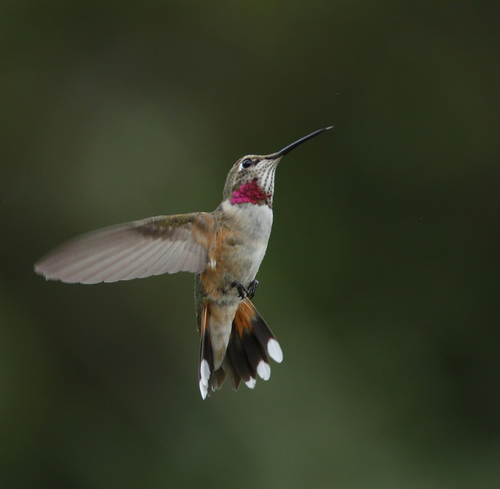
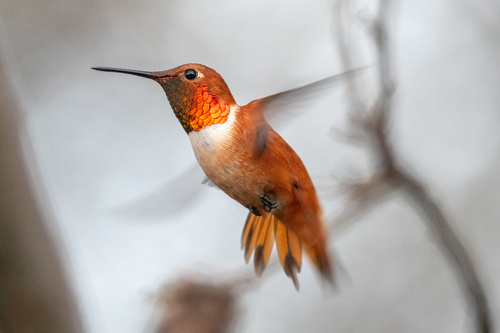
This species is scientifically named Selasphorus rufus (J.F.Gmelin, 1788), commonly known as the rufous hummingbird. Adult males have a white breast, rufous face, flanks and tail, and an iridescent orange-red throat patch called a gorget. Some males have green markings on their back, crown, or both. Females have green upperparts, white underparts, some iridescent orange feathers in the center of the throat, and a dark tail with white tips and a rufous base. Females are slightly larger than males. Females and rare green-backed males of this species are hard to tell apart from Allen's hummingbird. The characteristic notched shape of the second rectrix (R2) is an important field mark to distinguish adult male rufous hummingbirds from adult male Allen's hummingbirds. This is a typical small hummingbird, weighing 2–5 g (1⁄16–3⁄16 oz), measuring 7–9 cm (3–3+1⁄2 in) long, with a wingspan of 11 cm (4+1⁄2 in). For distribution and habitat, western rufous hummingbirds migrate through the Rocky Mountains and nearby lowlands from May to September to exploit the wildflower season. Some individuals remain in one local area for the entire summer; in this case, migrants, like breeding birds, often aggressively take over and defend feeding sites. Most individuals spend the winter in wooded areas of the Mexican state of Guerrero, traveling over 3,200 km (2,000 mi) overland from their nearest summer range — an exceptional journey for a bird that weighs only 3 to 4 g (3⁄32 to 5⁄32 oz). Adult male rufous hummingbirds usually migrate slightly earlier than females or young birds. Because juveniles and females of this species are nearly impossible to tell apart from Allen's hummingbird without close inspection, eastern rufous migrants are often classified as "rufous/Allen's hummingbirds". For feeding, rufous hummingbirds feed on flower nectar with a long extendable tongue, and also catch flying insects while on the wing. They need to feed frequently when active during the day, and enter torpor at night to conserve energy. Due to their small size, they are vulnerable to predation by insect-eating birds and other animals.