About Selasphorus heloisa (R.Lesson & Delattre, 1839)
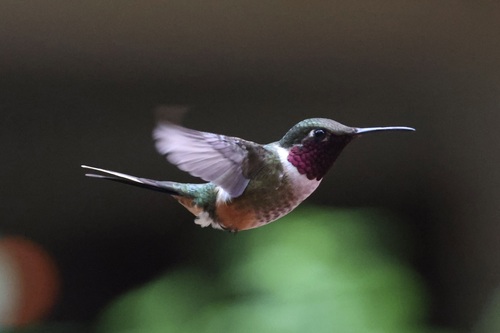
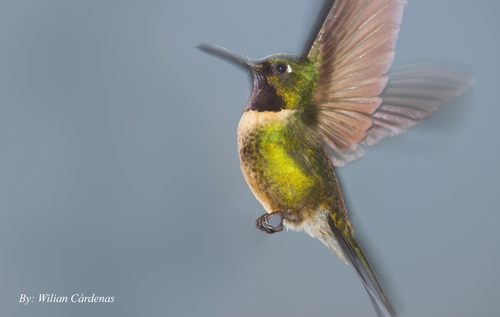
The bumblebee hummingbird (scientific name Selasphorus heloisa, originally described by R.Lesson & Delattre in 1839) is 5.9 to 7.5 cm (2.3 to 3.0 in) long and weighs 2 to 2.7 g (0.071 to 0.095 oz), making it one of the smallest hummingbirds. Both sexes of both recognized subspecies share a short, straight, blackish bill and a small white spot behind the eye. Males of the nominate subspecies (S. h. heloisa) have metallic bronze green to golden bronze upperparts. Their throat patch (gorget) is metallic magenta purple, transitioning to bluish purple at the edges, with longer rear-facing feathers that flare outwards and backwards. Their flanks are light reddish cinnamon with a bronze tint, while the rest of their underparts are dull white to grayish white. The central pair of tail feathers are bronzy green with some reddish cinnamon at the base. The next pair are reddish cinnamon on the basal half and black on the outer half, often with a bronzy green band separating the two colors. The remaining tail feathers are reddish cinnamon at the base, black in the middle (again often with an intervening bronzy green band), and have a wide white tip. Females of the nominate subspecies also have metallic bronze green to golden green upperparts. Their chin and throat are white with many scattered metallic bronze spots. Their flanks have more reddish cinnamon than those of nominate males, and the rest of the underparts are dull white to grayish white with a reddish cinnamon tint on the undertail coverts. Compared to males, the female's tail has less, duller reddish cinnamon and more black, and the tips of the outer tail feathers are off-white rather than bright white. The second subspecies, S. h. margarethae, is smaller than the nominate. Males have plumage similar to the nominate, but differ in having a dark amethyst violet gorget, pure white (rather than grayish white) underparts, and light buff (rather than reddish cinnamon) flanks. Females of S. h. margarethae have smaller metallic spots on the throat, light buff (rather than cinnamon) flanks and undertail coverts, and pure white tips on the tail feathers. The bumblebee hummingbird is native to both of Mexico's major mountain ranges. The nominate subspecies occurs in northeastern, central, and southern Mexico, ranging from Tamaulipas to Guerrero and Oaxaca. S. h. margarethae is found in northwestern and western Mexico, ranging from Sinaloa and Chihuahua to Jalisco. There is a single documented record of the species from the Huachuca Mountains in southeastern Arizona, United States. This species lives in a variety of montane habitats, including the interiors, edges, and clearings of semi-humid to humid pine-oak forest, evergreen forest, cloudforest, and humid scrubland. It occurs at elevations between 1,500 and 3,000 m (4,900 and 9,800 ft).