About Selasphorus flammula Salvin, 1865
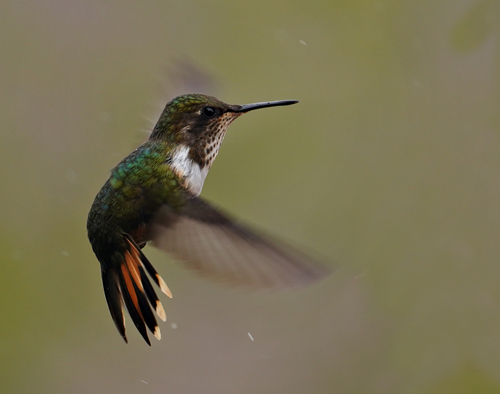
Selasphorus flammula, commonly called the volcano hummingbird, measures 7.5 to 8 cm (3.0 to 3.1 in) in total length. Males weigh approximately 2.5 g (0.088 oz), while females weigh about 2.8 g (0.099 oz). All subspecies of both sexes share a short, straight black bill, and a small white spot behind the eye. For the nominate subspecies, the adult male has bronze-green upperparts, outer tail feathers that are black with rufous edges, a mauve-purple gorget, and mostly white underparts. The sides of its breast have a buffy to pale cinnamon tint and green speckles. The adult female of the nominate subspecies is also bronze-green on its upperparts. Its central tail feathers are green; the rest of the tail feathers have rufous bases, a black band near the tip, and buffy to white tips. The female’s throat is whitish with dusky bronze speckles, and the rest of its underparts match the male’s underparts. Juvenile volcano hummingbirds are similar in appearance to adult females, but have buffy fringes on the upperpart feathers. Subspecies S. f. torridus has whiter underparts than the nominate for both sexes, and the male of this subspecies has a purplish-gray gorget. Both sexes of S. f. simoni are buffier on the underparts than the nominate, have more black on the tail, and males of this subspecies have a rose red gorget. Three subspecies of volcano hummingbird have distinct ranges in Central America. The nominate subspecies lives on Volcanoes Irazú and Turrialba in central Costa Rica. S. f. torridus occurs in the Cordillera de Talamanca of southern Costa Rica and on Volcán Barú in extreme western Panama. S. f. simoni is found on Volcanes Poás and Barva (also called Barba) in central Costa Rica. The species occupies a range of semi-open to open habitats on high mountain slopes. These habitats include páramo, second growth on landslide scars or ashfall areas, scrubby pastures, and the edges of elfin forest and taller forest. Most of the population is found between 2,000 and 3,500 m (6,600 and 11,500 ft) in elevation, though it occurs locally as low as 1,800 m (5,900 ft), and seasonally as low as 1,350 m (4,400 ft).