About Selago corymbosa L.
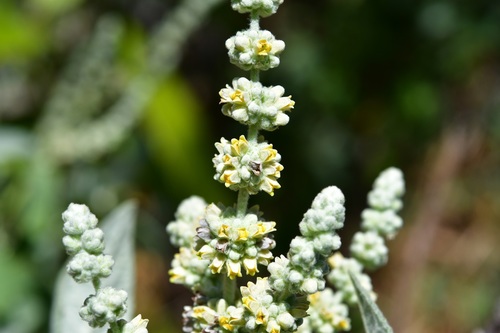
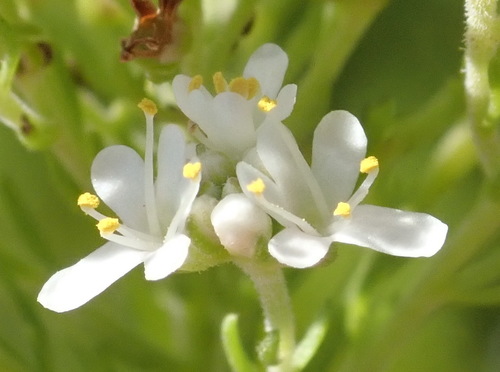
Selago corymbosa L. is a perennial, woody, loosely-branching shrublet. It belongs to a group of southern African Selago species, which also includes Selago dolosa, Selago punctata, and Selago variicalyx. All species in this group share three traits: fascicled leaves, pubescent stems, and a corymbose panicle inflorescence. Selago corymbosa is often confused with the closely related Selago dolosa, but it can be distinguished by several clear morphological features. The leaves of S. corymbosa are narrower, with a length to width ratio of 10-24 : 1, compared to 2.5-7 : 1 for S. dolosa. They are also longer, measuring 5-12mm instead of 2-7mm, and covered in more glandular hairs. Additionally, S. corymbosa leaves have a raised midrib on the lower surface and margins that recurve when dry. The bracts of S. corymbosa are also narrower, ranging from 0.4-0.7mm instead of 0.7-1.25mm. This species is mainly restricted to the southern Cape regions of South Africa. It grows best in grassy scrub vegetation, primarily in coastal lowlands, and can also spread into disturbed areas. In the western part of its range, it is common around the Cape Peninsula, Somerset West, Stellenbosch, and Paarl, extending north to the area around Ceres. Its eastern populations are found approximately between Knysna and Humansdorp. Between these two population groups, from Somerset West in the west to George/Knysna in the east, an intermediate form of Selago dolosa occurs that shows some morphological influence from Selago corymbosa.