About Selaginella apoda (L.) Spring
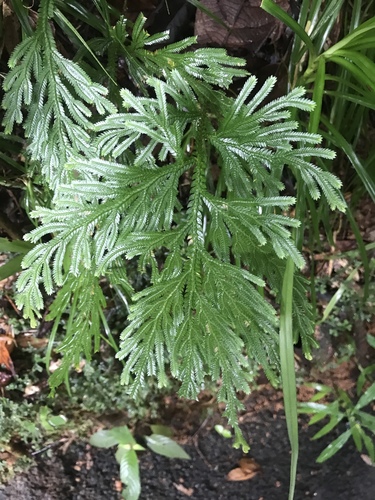
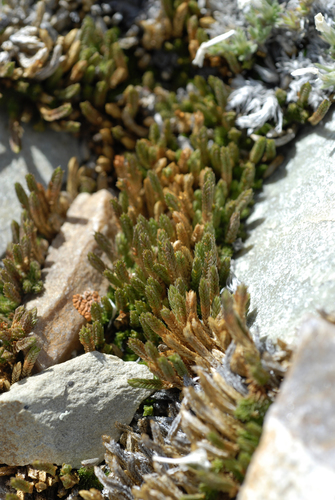
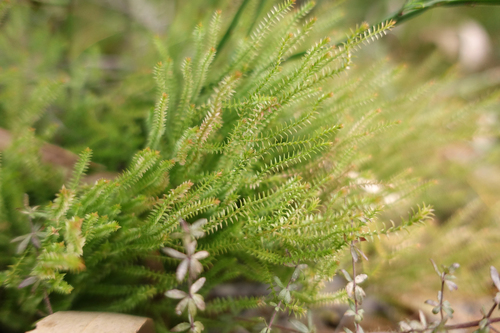
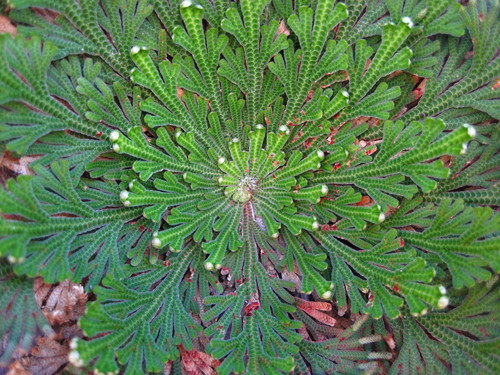
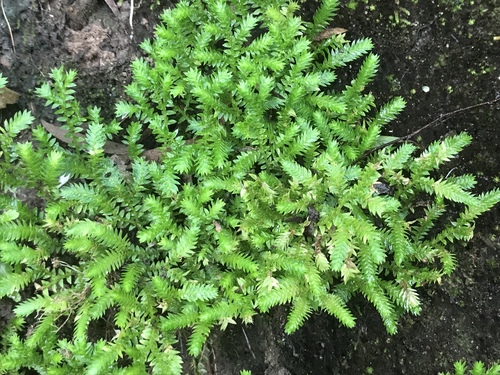
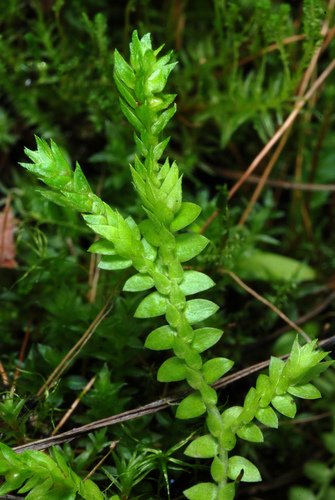
Selaginella apoda (L.) Spring has stems that bear two rows of smaller leaves and two rows of larger leaves. Unlike common mosses, its leaves have visible veins running along them, and its stem is distinctly leafy. Like other Selaginella species, it has rhizophores, and most Selaginella species exhibit dichotomous branching. The vegetative leaves of S. apoda are scale-like, short, edged with small teeth, and vary in shape and size at the same node. S. apoda has a creeping growth habit, with branches reaching a maximum height of 15 centimeters. Across Selaginella species, a single awl-shaped ligule grows from the adaxial (upper) surface of leaf bases and also on sporophylls. The adaxial surfaces of S. apoda leaves have a cuticle layer, and the abaxial (lower) leaf surfaces lack hairs. Internodes of S. apoda branches are extended on vegetative branches, a trait used to distinguish vegetative branches from reproductive ones. Both adventitious and primary roots of S. apoda have a root cap at their tip, can branch during growth, are white, and bear root hairs close to the root tip. The primary root system of S. apoda consists of only three individual root strands, is poorly developed, and does not branch significantly. Stomata on the lower (abaxial) leaf surface are found along the leaf margin, while stomata on the upper (adaxial) leaf surface are spread across the entire leaf lamina. The dorsal leaves of S. apoda have acuminate (tapered to a sharp point) apices. Primary leaves of S. apoda differ greatly in shape from the plant's cotyledons. The margins of S. apoda leaf blades are either light green or match the color of the leaf blade itself. The strobilus of S. apoda is usually 1 to 2 centimeters long and typically grows in an erect position. The two gametophyte forms of the species begin development inside the sporangia. S. apoda sporangia can be told apart from sporangia of other Selaginella species by their two-layered wall, while other Selaginella species have three-layered sporangia walls.
Genus Selaginella species are distributed across every continent except Antarctica. S. apoda is native to the Midwestern and Eastern United States. In the Americas, its natural range extends north to Maine in the United States and south to Guatemala. While it can be found across U.S. states bordering the Gulf of Mexico, larger populations grow in the Cumberland Mountains, the larger Appalachian Mountains range, and the piedmonts of these states, rather than in direct coastal environments. It can grow along lake or river shores, in meadows, in human-disturbed habitats, and in aquatic habitats such as rivers. S. apoda primarily thrives in heavily shaded environments with high soil moisture, including the edges of wetland marshes, oceanic cliffs, wetland meadows, bogs, the banks of running streams, and similar saturated environments.
Tropical regions host a diverse diversity of Selaginella species. Hybrid Selaginella species are rare, because they lack spore dispersal methods that allow spores to spread across long distances. S. apoda megaspores may be dispersed by wind or water. S. apoda can complete its full life cycle in as few as 85 days, a much shorter time frame than other species in the genus Selaginella. Scientists have confirmed that the length of S. apoda's life cycle depends heavily on habitat temperature, and researchers suggest that daylight duration may also play a key role in determining the species' life cycle length. The primary root system of S. apoda is fragile. Root hairs on S. apoda can survive for months, and mature before the root system penetrates the soil during early growth. As the plant increases in height, its roots, angle meristems, and rhizophores grow additional tissue. This extra growth allows the plant to spread across a large surface area without needing to transport large volumes of water. When the stem grows in a creeping habit, the lower surface of dorsal leaves and the upper surface of ventral leaves are exposed to sunlight, while the upper surfaces of dorsal leaves and the lower surfaces of ventral leaves face away from direct light. The length of S. apoda strobili and the number of microsporangia they contain depend on both the development season and the age of the strobilus. S. apoda is typically prostrate, meaning it grows flat against the ground.
Because S. apoda has simple growth requirements and a much shorter life cycle than other Selaginella species, it is used as a model organism for scientific study.