About Sedum palmeri S.Watson
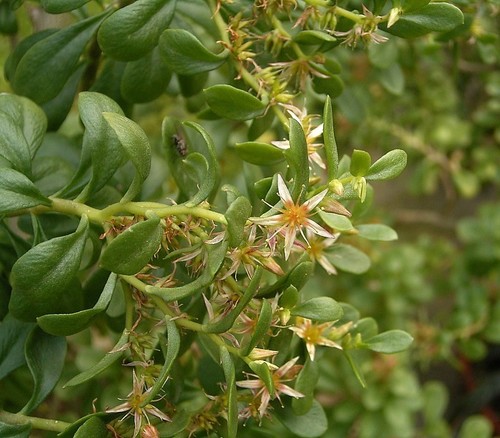
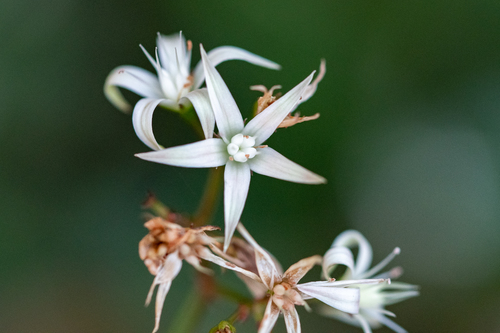
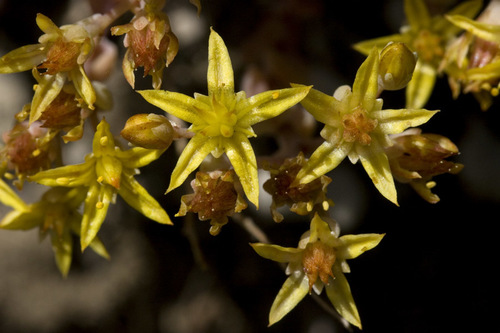
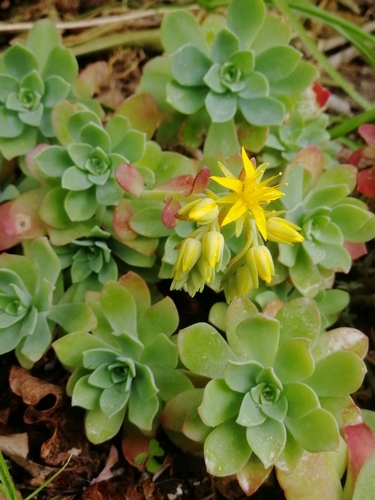
Sedum palmeri S.Watson is a smooth perennial subshrub with multiple slender, bending stems that grow between 15 and 25 cm (5.9 and 9.8 in) tall. Its light green leaves are alternately arranged and vary in shape, from narrowly spoon-shaped to broadly obovate. Leaves near the base are obovate with a false petiole; all leaves are rounded at the tip, either smooth or finely textured with small bumps, and covered in a bluish waxy coating. Leaves range from 10 to 30 mm in length. The flowering branches of Sedum palmeri stand upright, bearing loosely arranged flower clusters that form either panicle or corymb-like structures. The small bracts are somewhat oval. Each flower has five to seven segments and is attached by a stalk. The sepals are broad at the base, unequal in size, and oblong with slightly pointed tips, measuring 4 to 5.5 mm. The petals are partly fused at the base, oblong, slightly rounded at the tip, and broadly pointed, with a striking orange-yellow hue, reaching 6 to 7 mm in length. The nectar scales are wider than they are long and nearly flat. The styles are relatively long, and the fruiting bodies stand somewhat upright. Sedum palmeri typically grows in northeastern Mexico, particularly in the Sierra Madre Oriental north of the Guayalejo River, spanning areas of Tamaulipas, Nuevo León, and Coahuila. It is naturalized in Italy. Sedum palmeri is well-suited for cultivation in cool climates, as it tolerates low temperatures when kept dry. It thrives in hanging baskets, where its spreading habit and trailing flower stalks are showcased. It is hardy enough to be suitable for window boxes, stone troughs, and terracotta containers. However, it is less tolerant of wet conditions than Sedum oaxacatum, a species that shares a similar growth habit with it. While it can be grown outdoors in milder regions, it performs best in a conservatory or a sheltered porch where it can be protected from excessive moisture. Sedum palmeri is widely cultivated on windowsills in the Mediterranean region, particularly in Portugal, Spain, Italy, Greece, and various Mediterranean islands. This species propagates readily from cuttings, which has contributed to its widespread presence in Mediterranean towns and villages, where people frequently share it with friends and neighbors.