About Sedum album L.
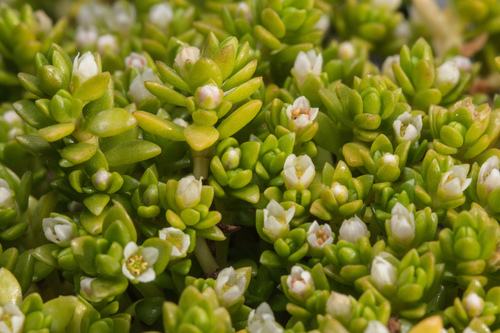
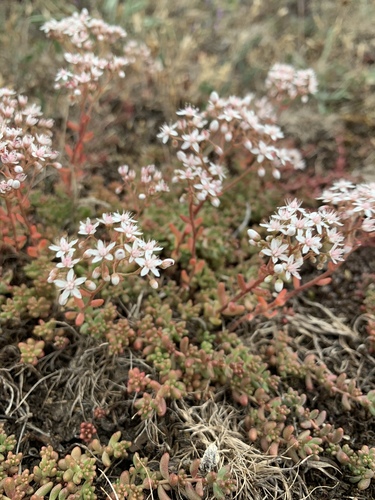
Sedum album L., commonly known as white stonecrop, is a tufted perennial herb that grows in mat-like stands. For most of the year, its stems are short, semi-prostrate, and densely covered in leaves. During its flowering period in July and August, stems lengthen to become erect, are occasionally branched, and often have a pinkish-brown color. Its leaves are alternate, fleshy, and nearly cylindrical with a blunt, rounded tip; leaves are also sometimes tinged with pink, especially in plants stressed by drought. Its starry flowers grow in a dense cyme. The calyx holds five fleshy sepals fused at the base, the corolla is made up of five regular white petals, there are ten stamens, a separate gynoecium, and five pistils. The fruit is five united, many-seeded follicles. As a low-growing species, white stonecrop cannot compete with more vigorous, fast-growing plants. It is specially adapted to growing on thin, dry soils, and can be found growing on walls, dry banks, seashore rocks, and in rocky meadows. For cultivation, it is hardy in Zones 3–9.