About Sebastes rubrivinctus (Jordan & Gilbert, 1880)
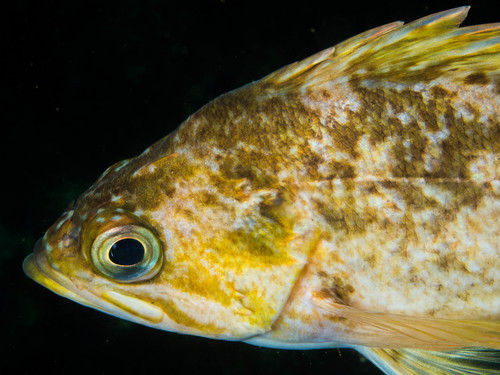
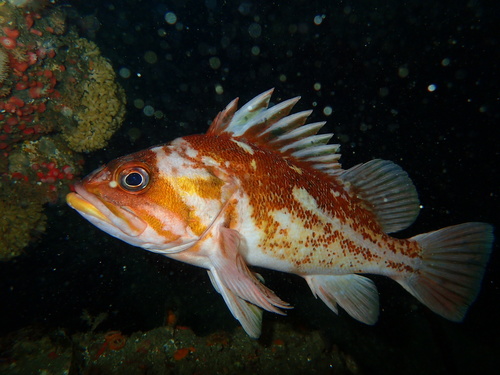
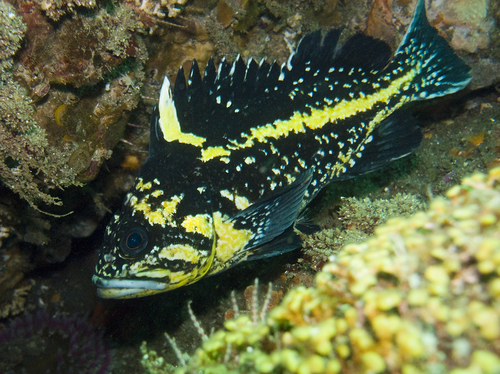
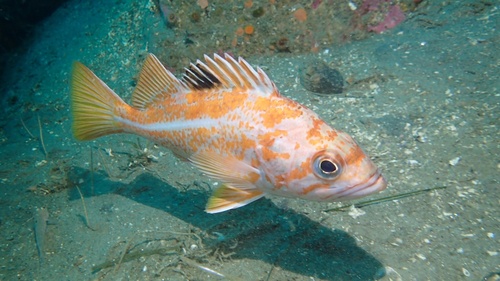
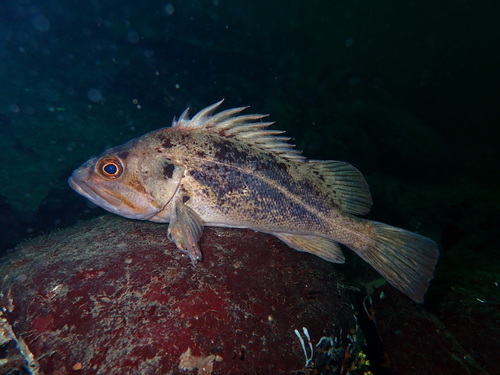
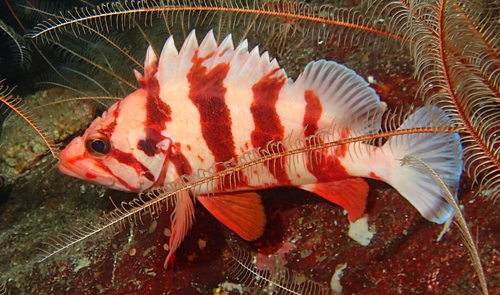
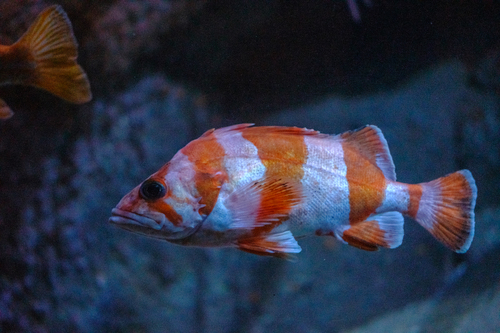
Sebastes rubrivinctus has a relatively slender, rhombus-shaped body, with body depth making up roughly one third of its standard length, and a thin, pointed head. Its dorsal fin has 13 spines and 12 to 15 soft rays. Its anal fin has 3 spines and 6 to 8 soft rays; the second anal spine is more robust and elongated than the third. The caudal fin is truncate. The fish's overall base color is white, with 4 vermilion bands across its body and 2 vermilion bands on its head. The band positioned at the front of the dorsal fin extends onto the operculum. As the fish ages, these bands fade, and the white base color becomes less bright. This species reaches a maximum total length of 51 cm (20 in), and has a maximum published weight of 1.5 kg (3.3 lb). Sebastes rubrivinctus occurs in the eastern Pacific Ocean, ranging from Cedros Island in Baja California north to Alaska, where it can be found as far west as Amchitka Island. This species, commonly called the flag rockfish, is a demersal fish that inhabits rocky reefs at depths down to 302 m (991 ft).