About Sebastes miniatus (Jordan & Gilbert, 1880)
Sebastes miniatus has a rather stocky body, where its body depth equals just under two-fifths of its standard length. It has head spines that range from moderately robust to weak; the nasal, preocular, supraocular, postocular, tympanic, and parietal spines are always present, the nuchal spine is usually absent, and the coronal spine is never present. Its dorsal fin is continuous, with a deep notch separating the spiny and soft-rayed sections. The spiny section has a longer base than the soft-rayed section, and there are deep incisions in the membranes between the spines. The dorsal fin contains 13 spines and 13 to 15 soft rays, while the anal fin has 3 spines and 7 soft rays. The lower jaw is rough and covered in large scales. This species has a deep caudal peduncle, and its caudal fin is slightly forked. It reaches a maximum total length of 91 cm (36 in) and a maximum published weight of 6.8 kg (15 lb).
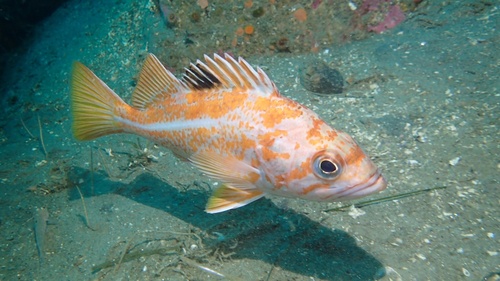
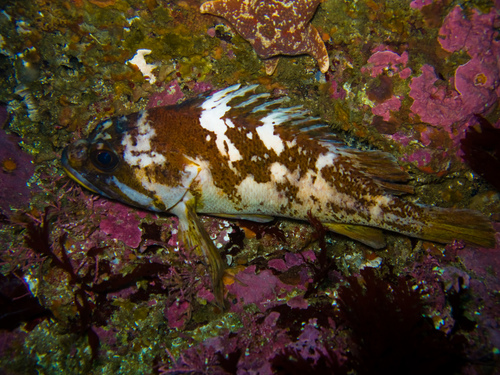
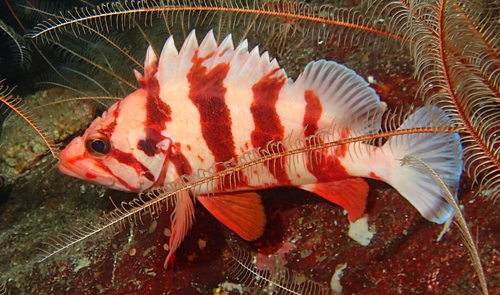
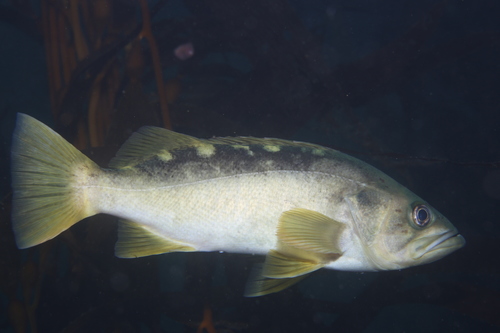
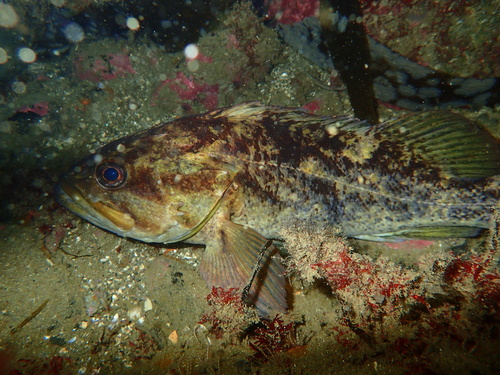
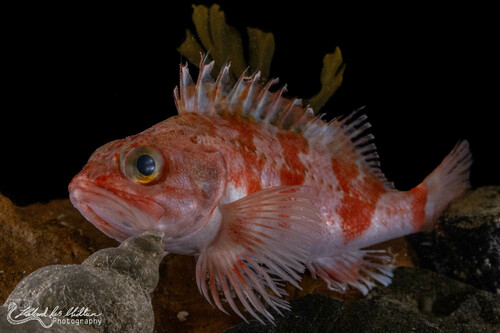
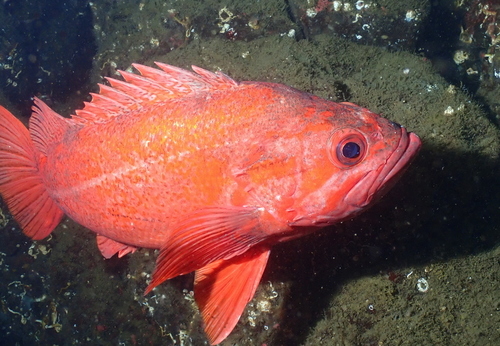
Its coloration ranges from dark red to vermilion, with gray or black spots on the back and flanks. Smaller individuals typically have a more mottled pattern than larger fish. The inside of the mouth is red, and the red fins often have black margins, a trait that is also more common in smaller fish. Larger individuals have indistinct dark markings on the head and back. Three indistinct yellow or orange stripes radiate out from the eyes, and the posterior two-thirds of the lateral line is silvery in color.
Sebastes miniatus is found in the eastern Pacific Ocean, ranging north from San Quintin, Baja California, Mexico to Prince William Sound, Alaska. It inhabits areas on and around rocky reefs, at depths between 6 and 250 m (20 to 820 ft).