About Sebastes melanops Girard, 1856
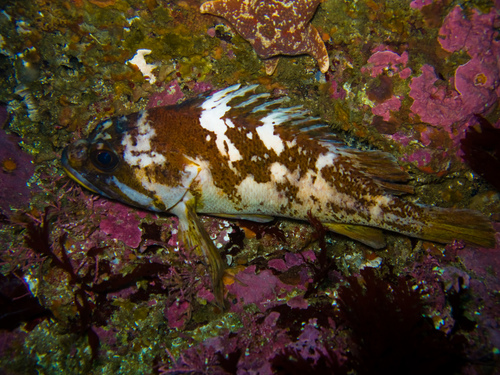
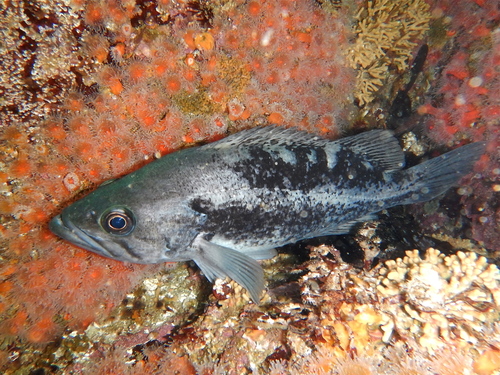
Sebastes melanops Girard, 1856, commonly called the black rockfish, reaches a maximum total length of 63 cm (25 in) and a maximum published weight of 4.8 kg (11 lb). It has a deep, laterally compressed fusiform body. The head has weak spination: only nasal spines are always present; preocular and postocular spines are normally absent; and supraocular, tympanic, coronal, parietal, and nuchal spines are always absent. The head has moderately sized eyes, a bulge in the intraorbital space, and the upper jaw extends to the posterior margin of the eye. The species has a continuous dorsal fin with 13 to 14 spines and 13 to 16 soft rays, with deep incisions in the membranes between the spines. The anal fin has a rounded posterior margin, with 3 spines and 7 to 9 soft rays. The caudal fin is truncate to emarginate. The overall body color is mottled grey and black, with a black spot on the posterior section of the spiny dorsal fin that fades as the fish grows. Adult individuals may have dark stripes on the head that run from the eye over the operculum. The dark coloration of the upper body is often paler than the coloration on the flanks, which creates the species' mottled appearance. This dark color fades to white on the underside. Black rockfish are distributed in the northeastern Pacific Ocean, ranging from Amchitka Island in the Aleutian Islands of Alaska to Santa Monica Bay in California. There are two recorded occurrences of this species from Iwate Prefecture in northern Japan. This species occurs on continental shelf waters and is associated with reefs. It can be found at depths down to 366 m (1,201 ft), but is more commonly found between 182 and 274 m (597 and 899 ft). It often inhabits areas of rocky reefs, and lives among kelp, as well as around jetties and other manmade structures.