About Sebastes maliger (Jordan & Gilbert, 1880)
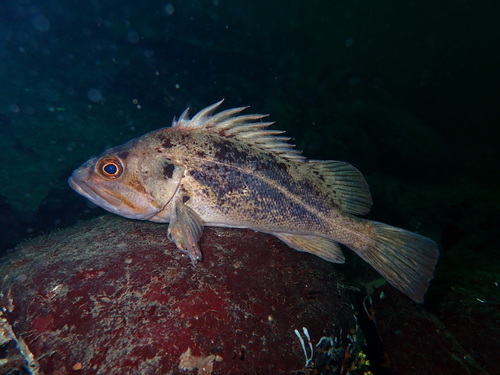
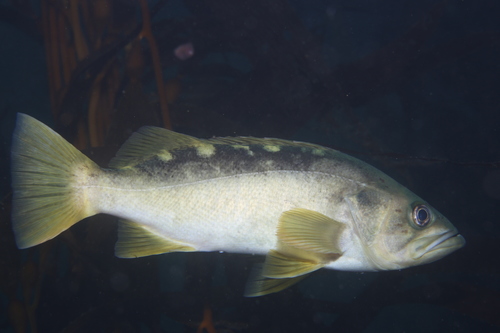
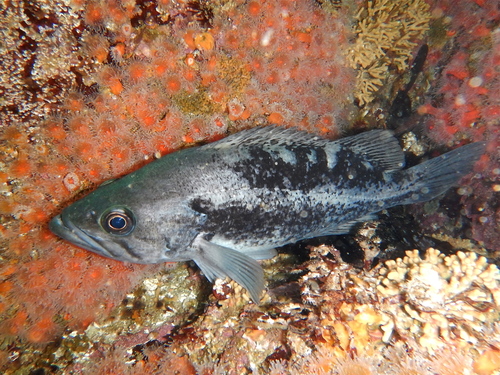
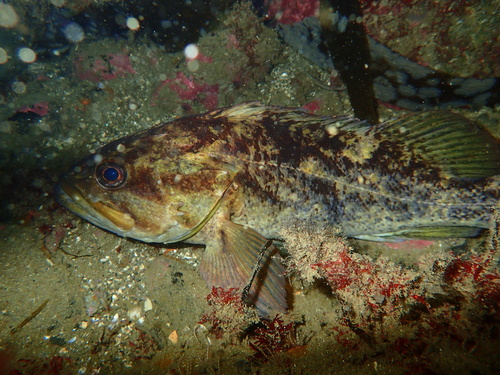
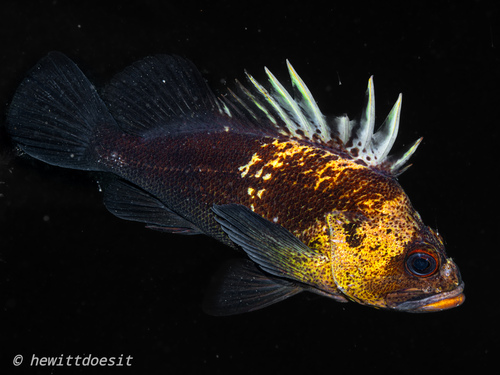
Description The quillback rockfish, Sebastes maliger, has a maximum recorded total length of 61 cm (24 in) and a maximum recorded weight of 3.3 kg (7.3 lb). Its head is protected by strong spines: nasal, preocular, postocular, tympanic, and parietal spines are present, while supraocular, coronal, and nuchal spines are absent. Its dorsal fin has 13 spines and between 12 and 14 soft rays; its anal fin has 3 spines and 6 or 7 soft rays. The dorsal fin spines are very long, and the membranes between these spines are deeply incised. The overall body color ranges from brown to black; on the anterior part of the body, this dark base color is interrupted by yellow to white spots and irregular markings that extend downward from the back. The body color becomes progressively darker toward the posterior. Dorsal fin spines are white or pale yellow, and may have dark brown or black markings. In some areas, this species has brown or orange speckling on the head that extends from the nape to the area underneath the pectoral fins. Distribution and habitat The quillback rockfish occurs along the Pacific coast of North America, ranging from the Gulf of Alaska to the northern Channel Islands of Southern California. Like other rockfish species, quillback rockfish are bottom-dwelling, perching on rocks or hiding in rock crevices. Juveniles mainly stay along shore in reefs, sandy areas, and eelgrass, while adults live in deeper water. Most quillback rockfish are solitary and are rarely found in groups. They are seldom found in the open ocean, and generally prefer to stay close to kelp, rocks, or coral, or shelter inside crevices or holes. Despite this sheltering behavior, they are not territorial. High population densities of this species typically correspond to areas of peak plant growth. This species occupies a variety of habitats across many areas of the west coast of North America. Depending on location, quillback rockfish are minimally to moderately migratory. On the high-relief rocky reefs of Puget Sound, Washington, individuals maintain small home ranges of 30 square meters. On low-relief reefs, individuals may stay within a larger area ranging from 400 to 1500 square meters. They sometimes move seasonally to low-relief reefs during the summer, when kelp is present there.