About Sebastes flavidus (Ayres, 1862)
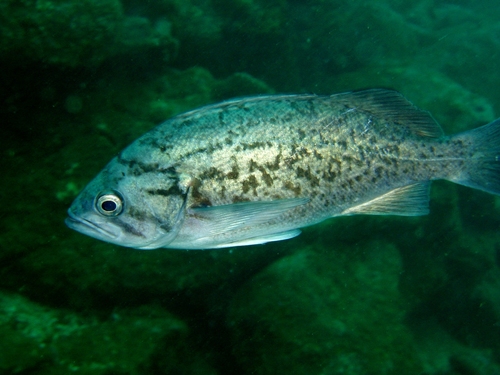
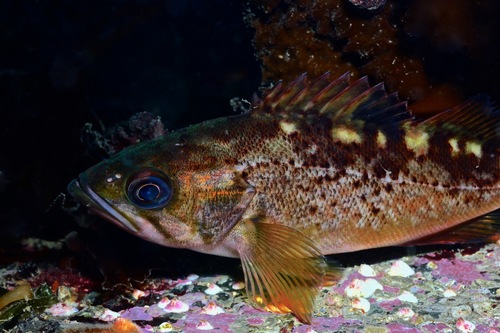
Sebastes flavidus, commonly called the yellowtail rockfish, has an elongate, compressed body with a depth that is roughly one-third of its standard length. Its head is relatively short, with a small terminal mouth and large eyes. It does not have robust head spines; only nasal spines are present, preocular and parietal spines are typically absent, and supraocular, postocular, tympanic, coronal, and nuchal spines are always absent. The dorsal fin contains 13 spines and 14 to 16 soft rays, while the anal fin has 3 spines and 7 to 9 soft rays. There may be a distinct knob on the symphysis of the lower jaw. This species reaches a maximum total length of 66 cm (26 in) and a maximum total weight of 2.5 kg (5.5 lb). The body is generally dark brown or greenish-brown, with pale or bright white blotches directly underneath the dorsal fins, and fades to white below the lateral line. The caudal fin is bright yellow, and all other fins are dusky yellow. After capture, the body darkens to a uniform olive green, the blotches fade, though reddish-brown speckling is often still visible on the rear margin of each scale. The yellowtail rockfish is distributed from San Quintin, Baja California, to Kodiak Island, Alaska. It is commonly found over deep reefs, ranging from the surface down to depths of 549 m (1,801 ft). Juveniles are often found around floats and pilings.