About Sebastes elongatus Ayres, 1859
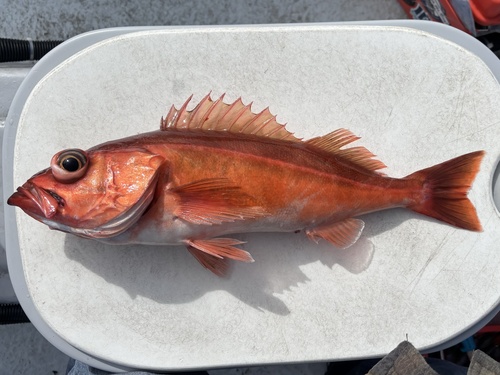
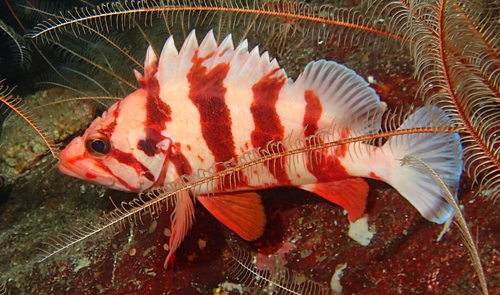
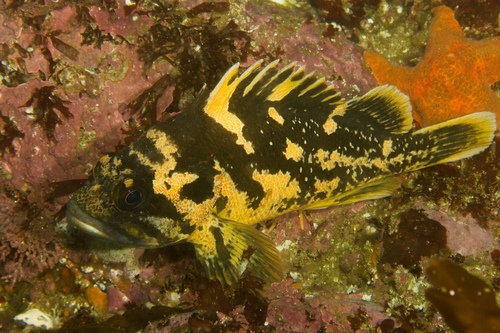
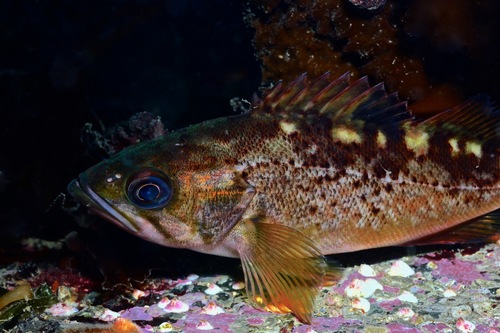
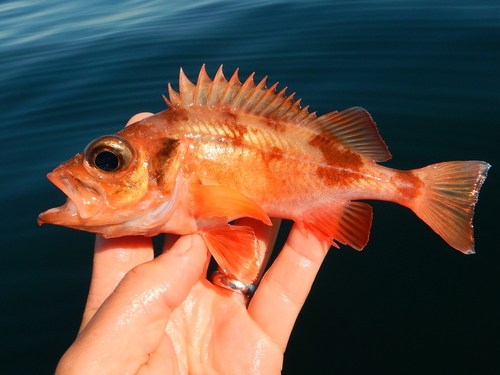
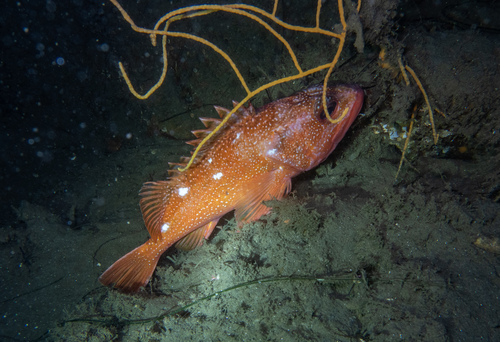
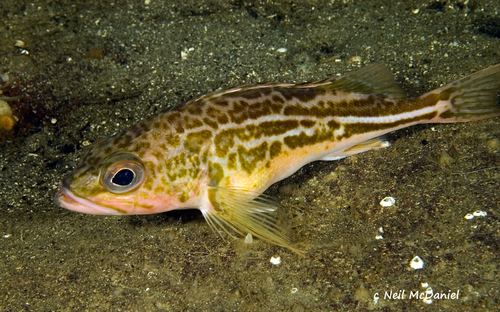
Sebastes elongatus has a comparatively slender, elongated, scaly body, whose depth is around one-third of its standard length. It has a moderately sized head and eyes. Venom glands are present in the spines of its dorsal, anal, and pelvic fins. Its caudal fin ranges from truncate to weakly crescent shaped. On the head, the nasal, preocular, postocular, tympanic, and parietal spines are robust and present, while the supraocular, coronal, and nuchal spines are absent. The dorsal fin has 13 spines and 12 to 14 soft rays, and the anal fin has 3 spines and 6 soft rays. This species reaches a maximum total length of 39 cm (15 in) and a maximum published weight of 630 g (22 oz). Its body color ranges from white to reddish, marked with four very distinct longitudinal green stripes, with two on each side of the lateral line. There is green streaking on the membranes of the caudal fin, and a red streak on the maxilla.
Sebastes elongatus occurs in the northeastern Pacific Ocean, along the western coast of North America, from Chirikof Island in the Gulf of Alaska to Cedros Island in Baja California. It is a demersal fish with a depth range of 25 to 425 m (82 to 1,394 ft), and is more typically found between 91 and 366 m (299 and 1,201 ft). It can be found in both inshore and offshore areas, and lives on both rocky and soft substrates.