About Sebastes auriculatus Girard, 1854
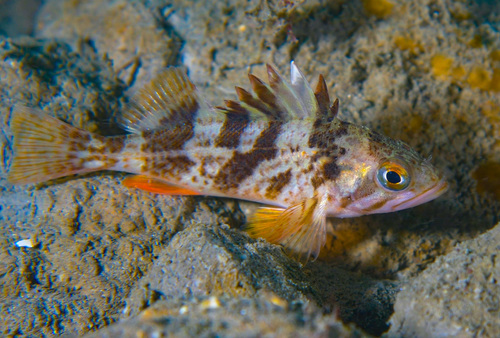
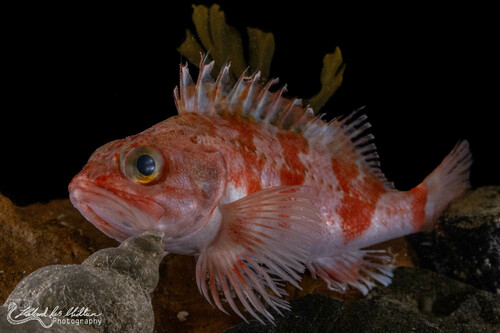
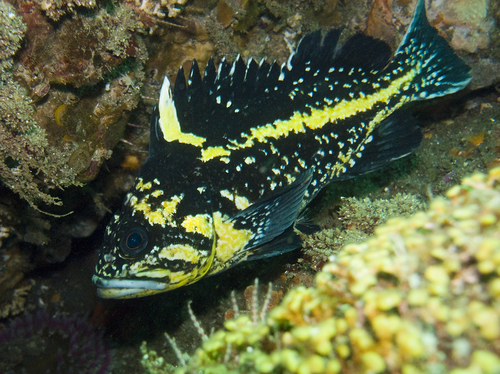
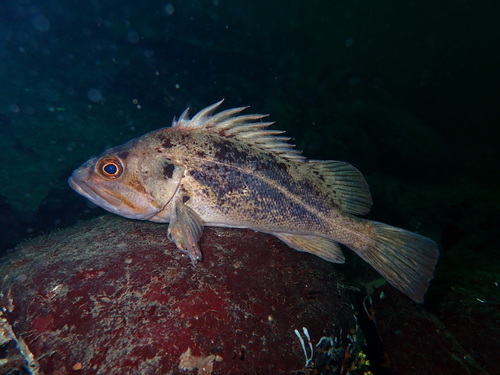
Sebastes auriculatus Girard, 1854, commonly called the brown rockfish, has a deep body, with body depth measuring 33% to 37% of its standard length. Most individuals have spines on the head, which bears a small terminal mouth. The fish's overall body color is reddish-brown with numerous dark markings, including a distinct dark spot at the rear upper angle of the operculum. The eyes often have a red or orange tint. Two orange or orange-brown lines run backward from the upper jaw and from the eye, respectively. The entire body is covered in scales. The head spines are robust and include nasal, preocular, postocular, tympanic, coronal, parietal, and nuchal spines. In some specimens, the coronal and nuchal spines may be absent, and this species never has supraorbital spines. The space between the eyes can be either flat or slightly bulging. The caudal fin is rounded or truncated. The dorsal fin has 13 spines and 12 to 15 soft rays, while the anal fin has 3 spines and 5 to 8 soft rays. This species reaches a maximum total length of 56 cm (22 in), and the maximum recorded weight for the species is 3.0 kg (6.6 lb). The brown rockfish is native to the northeastern Pacific Ocean. Its range stretches from southern Baja California north to Prince William Sound in the northern Gulf of Alaska. It is most abundant in the central and southern portions of Puget Sound, and along the coast from southern Baja California to Bodega Bay in northern California. This species can be found at depths ranging from the intertidal zone down to 287 m (942 ft). It prefers areas with rocky patches or hard substrates, and inhabits areas with relief ranging from low to high. It also frequently occurs around artificial structures and man-made objects, such as piers and marine debris like tires. Adult brown rockfish are primarily found in deeper waters, while juveniles live in shallower areas.