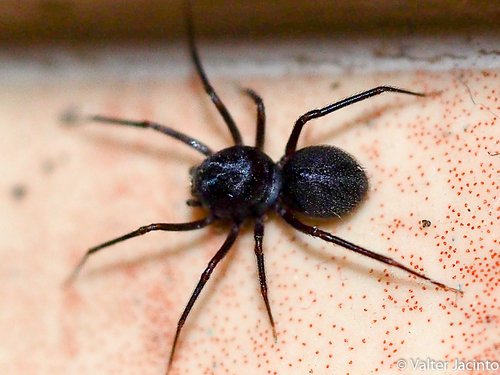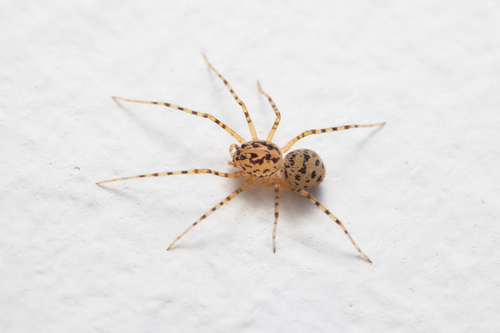
About Scytodes thoracica (Latreille, 1802)
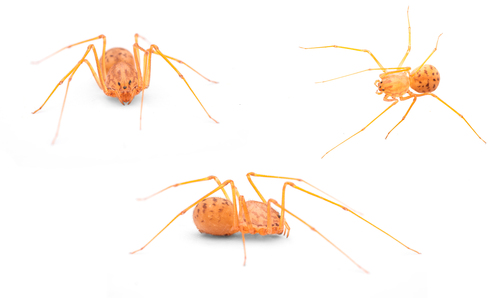
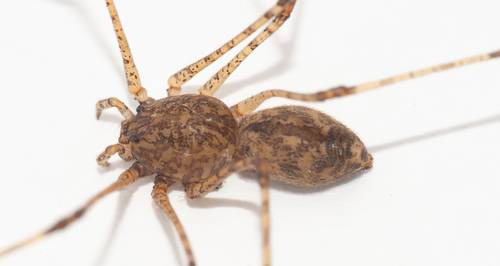
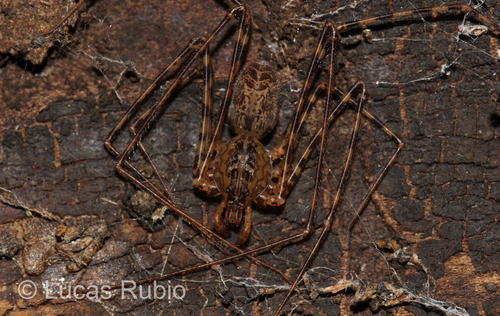
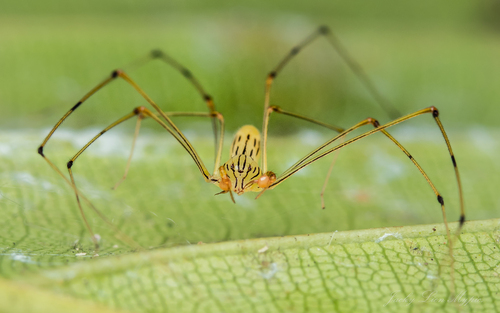
Scytodes thoracica, the spitting spider, gets its common name from how it spits a venomous, sticky silken substance over its prey. Adults range in size from 3 to 6 mm, or 0.12 to 0.24 inches. Its carapace has an unusual shape, sloping upwards toward its rear end, while its abdomen slopes downwards. As a member of the family Scytodidae, it has six eyes instead of the eight eyes that most spiders have. This spitting spider has silk glands located in its cephalothorax, in addition to the silk glands found in its abdomen. These cephalothoracic silk glands are connected to the spider's venom glands, allowing the species to produce venomous silk. Only a few other arachnids, like pseudoscorpions, also have silk glands in the cephalothorax. Scytodes thoracica is a cosmopolitan species. It is naturally found across Europe, North Africa, Turkey, and from temperate Asia through China, Korea, and Japan. It has been introduced to North America, Argentina, India, Australia, and New Zealand. In South Africa, it has been recorded in three provinces: Gauteng, KwaZulu-Natal, and Limpopo. In the United Kingdom, its range rarely extends beyond southern England, with very few confirmed sightings further north. This species is commonly found inside human houses, where it wanders in search of prey at night. In South Africa, it lives within the Grassland and Savanna biomes, at altitudes between 68 and 1444 meters above sea level. It is a wandering spider that is most often collected from under stones and in other dark spots on the soil surface. During reproduction, the mother carries her eggs in a silken net held under her abdomen. After spiderlings emerge, she builds a nursery web for them.