About Scytinium lichenoides (L.) Otálora, P.M.Jørg. & Wedin
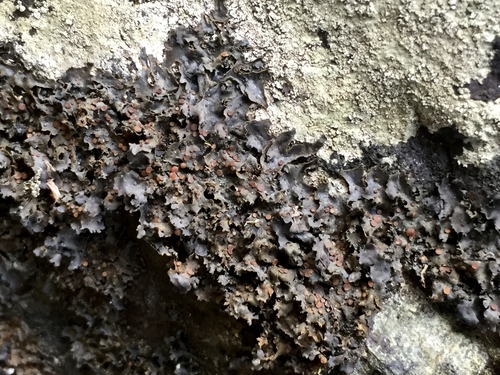
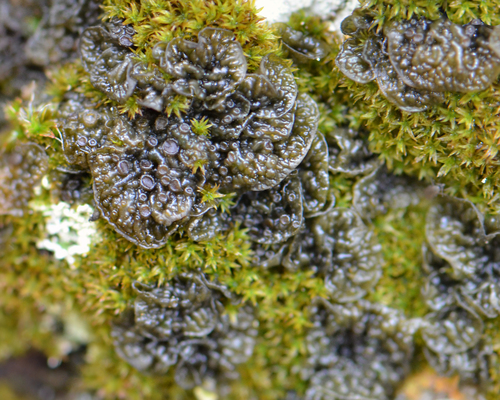
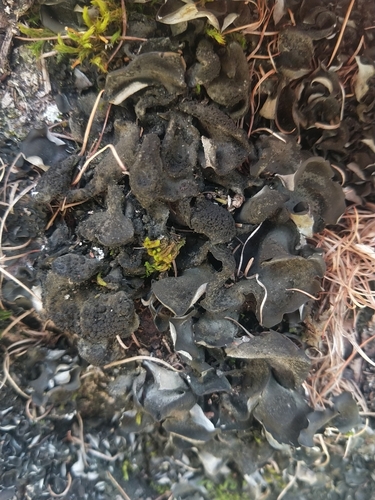
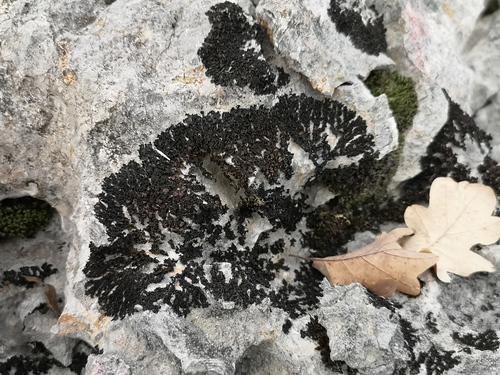
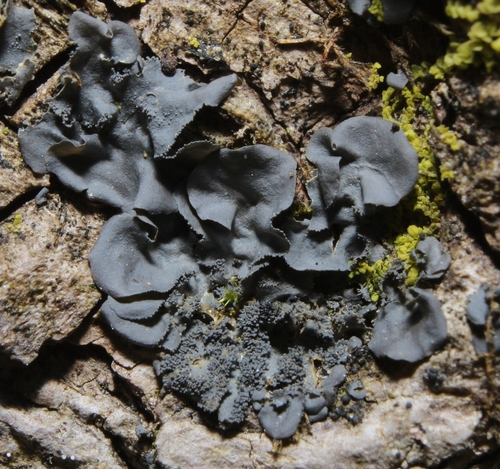
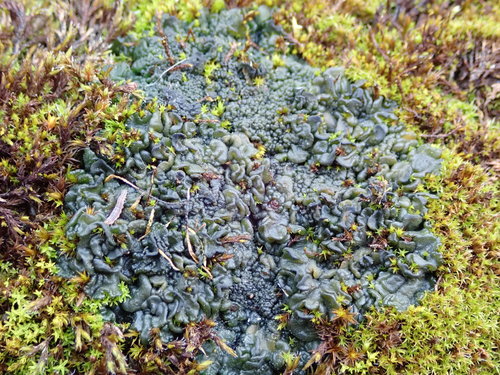
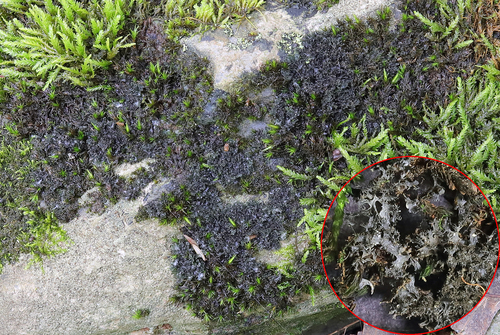
Scytinium lichenoides is a jelly lichen that produces often distinctly fringed lobes. Many small cylindrical outgrowths that resemble isidia — minute, finger-like vegetative propagules — grow along lobe margins, and sometimes across lobe surfaces. These outgrowths can be simple or branched, and may grow dense enough to give lobe edges a fibrillose appearance. The upper surface of the thallus ranges from smooth to wrinkled, sometimes with a small number of ridges, and is typically shiny. The lower surface usually has prominent, often vertically oriented ribs, and may develop a slight cobwebby texture near the base. In cross-section, the thallus has a distinct cortex made of angular cells, which sits above a medulla of intertwined fungal hyphae. Its fruiting bodies, called apothecia, are uncommon and tiny, measuring 0.3–1 mm across. They have a thalline margin that also bears isidia. The ascospores are muriform, meaning they are split by internal septa into a brick-like pattern. They typically measure 33–45 μm long, and occasionally range from 26–50 μm long, by 12–15 μm wide. Most have around seven transverse septa, with a total range of five to nine. This species usually grows within moss cushions on rock, or on thin soil that covers rock. It can also grow on the lower sections of tree trunks in climates that stay consistently moist. Regional field guides consistently note that Scytinium lichenoides prefers base-rich substrates. It is commonly found growing on mossy calcareous rock in northern Canada, mixed with moss on outcrops and scree in the Pacific Northwest, and among mosses over rocks in montane forests of the Sonoran Desert region. The species is widespread across the Holarctic. It occurs across Arctic and boreal regions of North America, extends through temperate zones south to Arizona and Baja California, and is well documented across all of Europe. It grows at elevations from montane to subalpine, and has many confirmed records within the British Isles.