About Scythrops novaehollandiae Latham, 1790
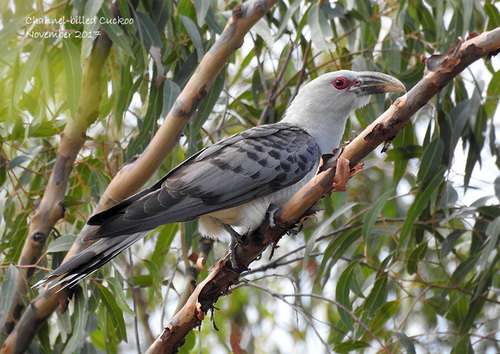
The channel-billed cuckoo, with the scientific name Scythrops novaehollandiae Latham, 1790, is the world's largest cuckoo species. It measures 56–70 cm (22–28 in) in length, has a wingspan of 88–107 cm (35–42 in), and weighs between 560–935 g (1.235–2.061 lb). A sample of 24 adult channel-billed cuckoos had an average body mass of 684 g (1.508 lb). According to an avian body mass manual, another cuckoo species, the buff-headed coucal, may have a mean body mass around 11% higher than the channel-billed cuckoo. Its bill is large, slightly curved, and bi-coloured, with a grey base that becomes straw-coloured at the tip. The bill's shape resembles that of hornbills, so this species is sometimes mistakenly called a hornbill. Adult channel-billed cuckoos have pale grey plumage on the head, chest, belly, and back; the lower belly is paler and barred. The wings are darker grey with dark feather tips. The upper surface of the tail is dark grey, the underside is barred, and the tail ends with a black band and a white tip. The legs and feet are black, and prominent red skin surrounds the eye. Unlike most other very large cuckoos, which are mostly terrestrial (such as roadrunners and members of the genus Neomorphus), the channel-billed cuckoo is fairly arboreal and is capable of moving well both in trees and on the ground. It is a strong flier, with a distinctive, almost hawk-like cross-shaped (cruciform) flight silhouette. There is some sexual dimorphism in both plumage and size: females have a smaller bill and paler, more heavily barred undersides. Juvenile channel-billed cuckoos are similar to adults, but have pale tips on the wing feathers, and the rest of their plumage is buff instead of pale grey. Juveniles also have a less massive, dirty pink bill, and lack the red skin around the eye. The channel-billed cuckoo has a widespread distribution across northern and eastern Australia, New Guinea, the Bismarck Archipelago, and the islands of eastern Indonesia extending west to Sulawesi. The species is a permanent resident in the Bismarck Archipelago, Flores, and Sulawesi; it is migratory in other parts of its range. Channel-billed cuckoos that breed in Australia are found from north-eastern Western Australia through the Northern Territory and Queensland, south into eastern New South Wales as far as Sydney. In recent years, the breeding range of these Australian cuckoos appears to have extended further south along the south coast of New South Wales. A small number of stragglers reach the eastern tip of Victoria, but are not thought to breed there. Vagrant individuals have been recorded in New Zealand and New Caledonia. After the breeding season, in March and April, Australian-breeding channel-billed cuckoos start migrating north to their wintering grounds in New Guinea and Indonesia. Birds that breed in New South Wales begin leaving earlier, in February and March. Their migration route crosses the Torres Strait, and they travel either individually or in small groups. From New Guinea, they continue migrating across nearby islands as far west as Timor and the Moluccas. It is not confirmed whether the species breeds in New Guinea, as some channel-billed cuckoos are present there year-round. Migrating channel-billed cuckoos start returning to Australia in August and September.