About Scyliorhinus stellaris (Linnaeus, 1758)
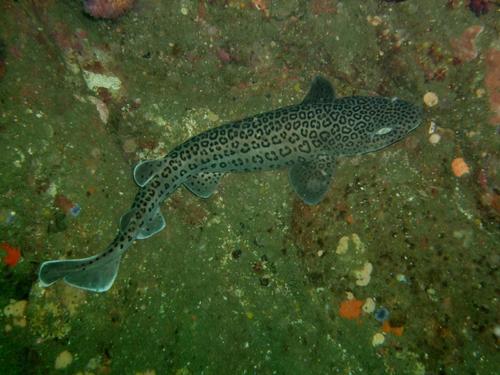
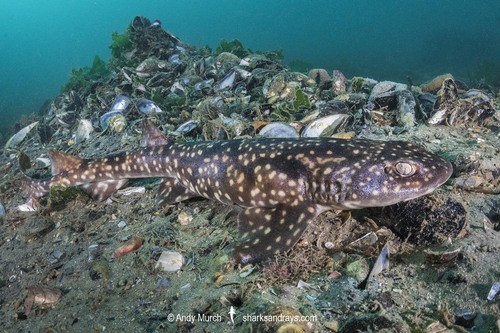
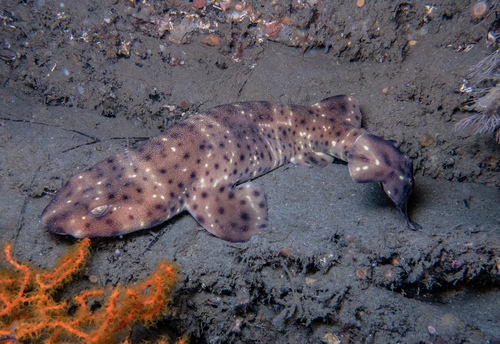
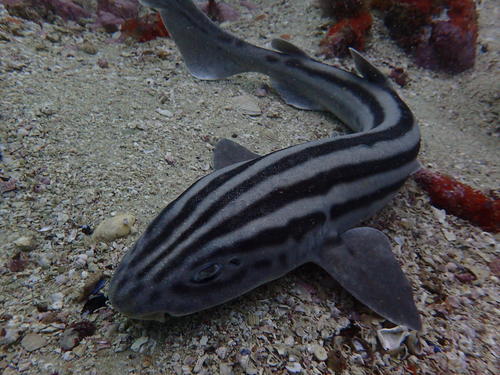
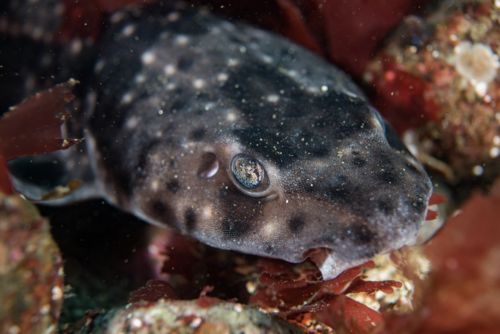
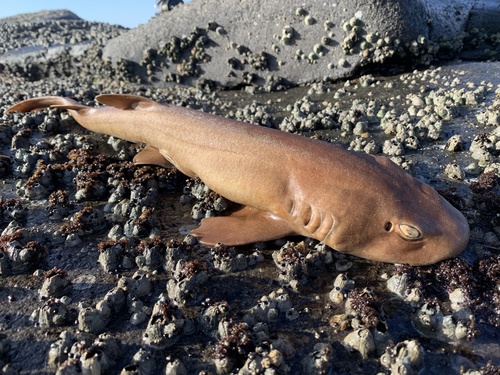
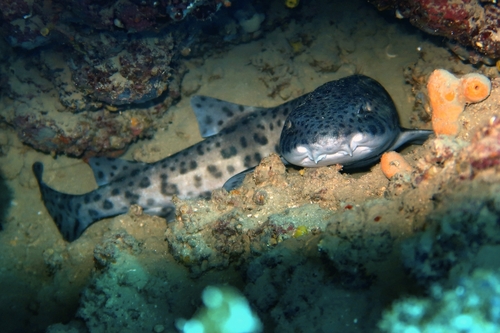
The nursehound, Scyliorhinus stellaris, can reach a maximum length of 1.6 m (5.2 ft), though most individuals grow to less than 1.3 m (4.3 ft). This shark species has a broad, rounded head and a stout body that tapers toward the tail. Its eyes are oval-shaped, with a thick fold of skin on the lower rim but no nictitating membrane. Unlike the small-spotted catshark, the large skin flaps beside the nursehound's nostrils do not extend to reach the mouth. In the upper jaw, there are 22 to 27 tooth rows on either side, plus 0 to 2 teeth at the symphysis, the jaw's center. In the lower jaw, there are 18 to 21 tooth rows on either side, plus 2 to 4 teeth at the symphysis. Nursehound teeth are Y-shaped with smooth edges. Anterior teeth have a single central cusp, while posterior teeth have an extra pair of small lateral cusplets. Teeth become progressively smaller and more angled further back in the jaws, with proportionally larger lateral cusplets. The species has five pairs of small gill slits, with the last two positioned over the bases of the pectoral fins. Its two dorsal fins are set far back on the body; the first dorsal fin is larger than the second and originates over the bases of the pelvic fins. The pectoral fins are large. In males, the inner edges of the pelvic fins are merged into an "apron" that covers the claspers. The caudal fin is broad, nearly horizontal, and has an indistinct lower lobe. The nursehound's skin is very rough, because it is covered in large, upright dermal denticles. The species has a grayish or brownish base body color, with small black dots covering its back and sides, interspersed with brown spots of varying shapes that are larger than the pupil. Its patterning is highly variable between individuals and across different ages. It may also have white spots; the brown spots may expand to turn almost the entire body dark; or a series of faint "saddle" markings may be present. The underside is solid plain white. Nursehounds are found in the northeastern Atlantic, ranging from southern Norway and Sweden to Senegal. This range includes waters off the British Isles, the entire Mediterranean Sea, and the Canary Islands. They may occur as far south as the mouth of the Congo River, though these West African records may be misidentifications of the West African catshark, S. cervigoni. The nursehound's overall range is patchy, especially around offshore islands, where small local populations have limited genetic exchange between groups. This bottom-dwelling species can be found from the intertidal zone down to a depth of 400 m (1,300 ft), though it is most commonly encountered between 20 m (66 ft) and 60–125 m (197–410 ft). It prefers calm water over rough or rocky terrain, including areas with algal cover. In the Mediterranean, nursehounds favor algae-covered coral habitats. Nursehounds are primarily nocturnal: they spend the daytime inside small rock cavities, and swim into deeper water to hunt at night. Sometimes two sharks will fit into the same rock hole, and multiple individuals will choose refuges within the same local area. One tracking study recorded a single immature nursehound that used five different refuges in sequence over 168 days, consistently returning to each refuge for multiple days before moving to the next. Nursehounds may use refuges to hide from predators, avoid harassment by mature members of their own species, and/or support thermoregulation. In captivity, nursehounds are gregarious and tend to rest in groups, though the individual members of any given group change frequently. This species is less common than the small-spotted catshark. The nursehound preys on a wide range of benthic organisms, including bony fishes such as mackerel, deepwater cardinalfishes, dragonets, gurnards, flatfishes, and herring, and smaller sharks including the small-spotted catshark. It also eats crustaceans, especially crabs, plus hermit crabs and large shrimp, as well as cephalopods. When the chance arises, the nursehound will also scavenge. Compared to juveniles, adult nursehounds eat relatively more bony fish and cephalopods, and fewer crustaceans. Documented parasites of this species include the monogeneans Hexabothrium appendiculatum and Leptocotyle major, the tapeworm Acanthobothrium coronatum, the trypanosome Trypanosoma scyllii, the isopod Ceratothoa oxyrrhynchaena, and the copepod Lernaeopoda galei. The netted dog whelk, Nassarius reticulatus, preys on nursehound eggs by piercing the egg case to remove the yolk.