About Scutus breviculus (Blainville, 1817)
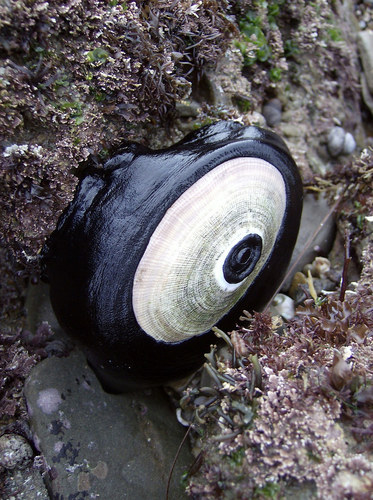
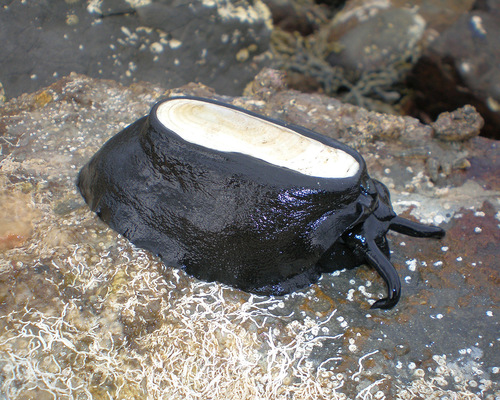
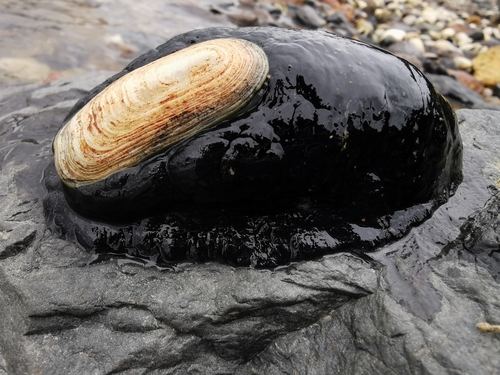
Like most other species in the Scutus genus, Scutus breviculus has a large muscular mantle. Folds of this mantle can completely cover the organism’s whitish shell, giving the animal a slug-like appearance. S. breviculus has a glossy, dark, almost jet black body, and its thick tentacles and snout share this same dark colouration. These animals live in the sub-littoral fringe, avoid light, and cling to the undersides of large rocks and boulders across a wide range of habitats, typically at depths down to 20 metres. They move around to feed at night, usually browsing on various algae such as Hormosira or Ulva sp. in estuaries and harbours. They often return to the same bare scar in the rock where they spent the previous day, a behaviour commonly referred to as homing behaviour. S. breviculus was an ancient food source for the Māori, who called the species rori, a common name used for larger slug-like marine animals. This species can grow up to 240 millimetres in length and weigh more than one kilogram. This species is distributed around and within New Zealand and across southern Australia. It is notably absent from the Chatham Islands.