About Scutigera coleoptrata Linnaeus, 1758
Scientific name: Scutigera coleoptrata Linnaeus, 1758
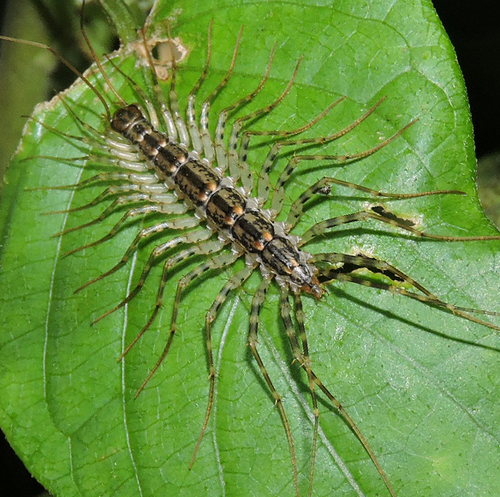
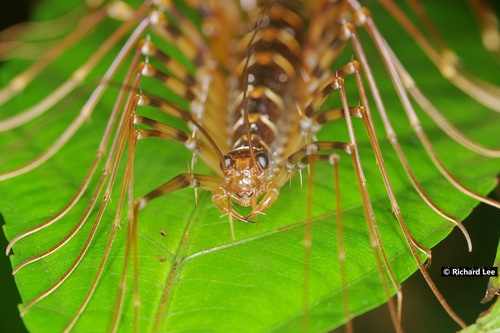
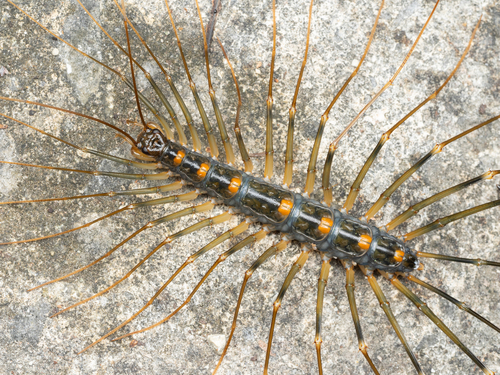
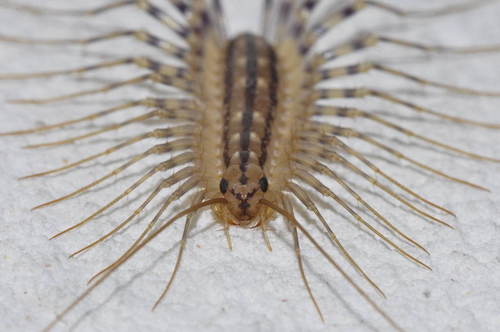
Morphology Adult Scutigera coleoptrata (house centipedes) typically have a body length of 25 to 35 mm (1.0 to 1.4 in), though larger individuals are sometimes found. Up to 15 pairs of long legs attach to their rigid body; when the legs and antennae are included, the centipede’s total apparent length reaches 75 to 100 mm (3 to 4 in). Their slender legs let them reach running speeds of up to 0.4 meters per second (1.3 ft/s) when moving across floors, up walls, and along ceilings. Their body is yellowish-gray with three dark stripes running lengthwise along the back, and their legs also bear dark stripes. S. coleoptrata has evolved automimicry: its tail-like hind legs look identical to antennae. When the centipede is resting, it is hard to tell its head end from its tail end. Unlike most other centipedes, house centipedes and their close relatives have well-developed faceted eyes.
Habitat Outdoors, house centipedes favor cool, damp habitats. Their respiratory system lacks any way to close their spiracles, so they require environments that protect them from dehydration and extreme cold. Most individuals live outdoors, primarily under large rocks, in woodpiles, in bark accumulations, and especially under piles of leaves or compost. They often come out of hiding when gardens or flowerbeds are watered. These centipedes can be found in almost any area of a home, though they are most often encountered in dark or dimly lit spaces like basements and garages. Inside homes, they are common in humid areas such as bathrooms, washrooms, and kitchens, but they can also be found in drier rooms including offices, bedrooms, and dining rooms. They are usually seen crawling along the ground or floor, but they are able to climb walls and can move very quickly when startled. They are most likely to be encountered in spring, when they emerge as weather warms, and in autumn, when cooling temperatures drive them to seek shelter in human homes.
Distribution Scutigera coleoptrata is native to the Mediterranean region, but it has spread across most of Europe, Asia, North America, and South America. It has also been introduced to Australia.
Reproduction and development House centipedes lay their eggs in spring. A laboratory observation of 24 house centipedes recorded an average of 63 and a maximum of 151 eggs laid per individual. Like many other arthropods, larvae resemble small versions of adult house centipedes, but they have fewer legs. Newly hatched young centipedes have four pairs of legs. They gain one new pair of legs during their first molt, and two pairs with each of their five following molts. Adults that have reached 15 pairs of legs keep this leg count through three additional molting stages, following the sequence: 4-5-7-9-11-13-15-15-15-15 pairs. House centipedes live between three and seven years, depending on their environment. They reach breeding age in their third year. To start mating, the male and female circle each other and first make contact with their antennae. The male deposits his sperm on the ground, and the female then uses the sperm to fertilize her eggs.
Behavior and ecology House centipedes prey on spiders, bed bugs, termites, cockroaches, silverfish, ants, and other household arthropods. They inject venom into prey by stinging with specialized appendages called forcipules. They are mostly nocturnal hunters. Despite having well-developed eyes, they appear to rely mostly on their antennae, which are sensitive to both smell and touch, when hunting. They use both their mandibles and their legs to hold prey, which lets them handle multiple small insects at once. To capture prey, they either jump onto it or use their legs in a capture technique called "lassoing". They have also been observed beating prey with their legs. Like other centipedes, they are capable of stridulation. In one feeding study, S. coleoptrata was able to distinguish between different potential prey items and avoided dangerous insects. They also adjusted their feeding behavior to match the level of danger a given prey posed; for example, they retreat after injecting venom into wasps to let the venom take effect before attacking. When the centipede itself is at risk of being preyed on, it can detach any legs that have become trapped. House centipedes have been observed grooming their legs by curling around and cleaning them with their forcipules. In 1902, C. L. Marlatt, an entomologist with the United States Department of Agriculture, published this short description of the house centipede: It may often be seen darting across floors with very great speed, occasionally stopping suddenly and remaining absolutely motionless, presently to resume its rapid movements, often darting directly at inmates of the house, particularly women, evidently with a desire to conceal itself beneath their dresses, and thus creating much consternation.