About Scorpis violacea (Hutton, 1873)
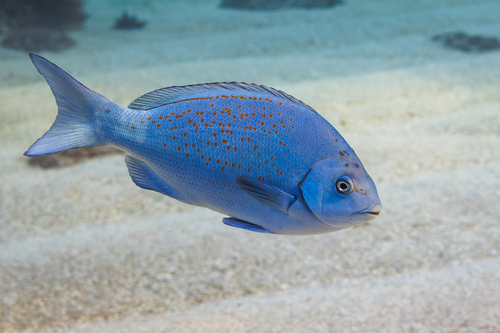
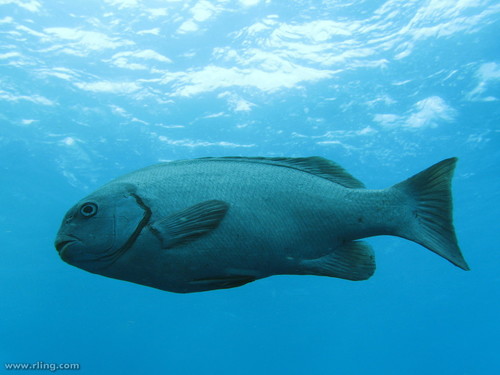
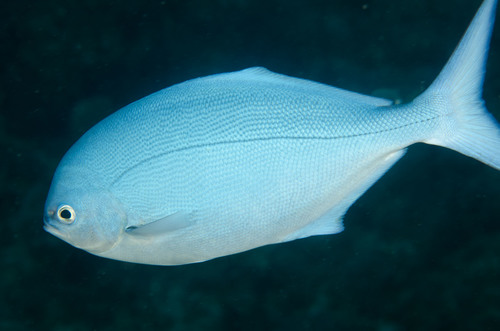
Blue maomao, whose scientific name is Scorpis violacea (Hutton, 1873), have a laterally compressed, relatively deep body and a noticeably forked tail. They have protrusible jaws fitted with multiple rows of small, closely spaced teeth, which they use to capture larger zooplankton. Adult blue maomao are deep blue on their dorsal side and pale on their ventral side, and they change color to a mottled dark green at night. Juveniles are grey, with a yellow anal fin. This species can reach a fork length of 45 centimetres (18 in). The dorsal fin has 9 spines and 27 soft rays, while the anal fin has 2 spines and 25 soft rays.
Blue maomao was first formally described in 1873 by Frederick Hutton as Ditrema violacea, with the type locality given as Wellington, New Zealand. This fish is found in the southwestern Pacific Ocean, around the North Island of New Zealand and the Kermadec Islands, and it has also been recorded in Australia. It is a schooling fish that lives in inshore waters, especially rocky areas. It feeds on zooplankton, but will graze on algae when zooplankton are scarce. When they feed in schools chasing shrimp near the surface, they can cause the water to foam. At night, each blue maomao has a preferred sleeping spot among the rocks, which matches its color change from blue to mottled green; they may occasionally sleep in groups over sheltered, sandy areas. Blue maomao are tactile fish: when not feeding, they rub themselves on pebbles, and they will visit cleaner fish even when they do not appear to need cleaning. Their spawning season runs from September to November, and juveniles have been recorded from October to December. Their eggs are 0.8 mm in diameter and contain an oil droplet, and these fish can live up to 15 years old.