About Scorpis aequipinnis Richardson, 1848
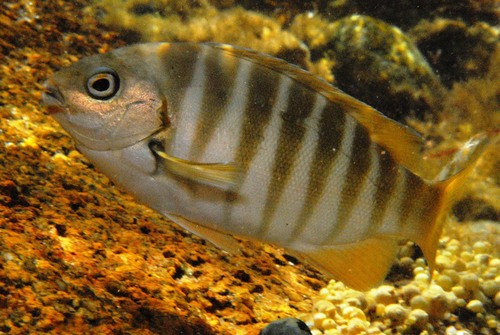
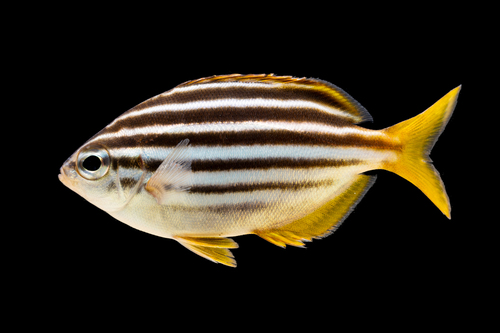
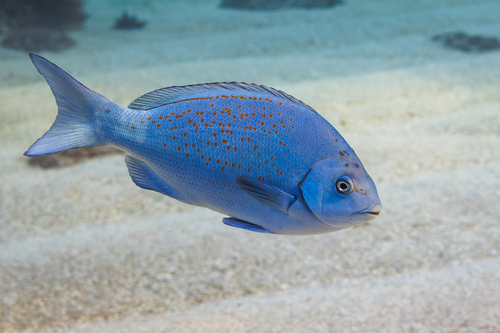
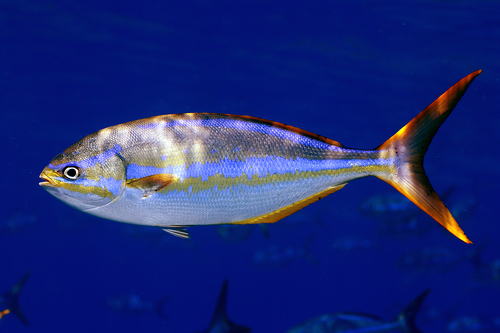
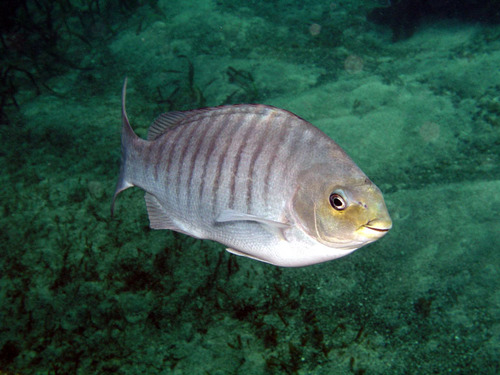
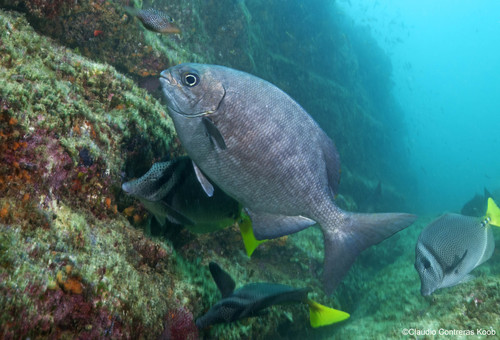
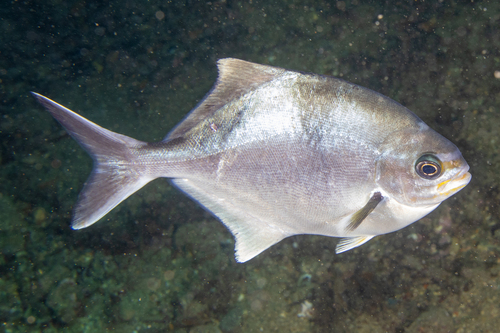
Scorpis aequipinnis Richardson, 1848, commonly called the sea sweep, has a deep, strongly compressed body with a thin caudal peduncle. Its head is moderately sized with an almost straight dorsal profile, a short snout, and quite large eyes. The mouth is small and oblique, holding small but strong teeth in the jaws arranged in broad bands; the outer band has enlarged, recurved teeth. Most of the body is covered in very small ctenoid scales, and it has a gently curved lateral line. The dorsal fin is continuous, starting with a very short first spine. There are 10 spines total that progressively become taller toward the tail, and the first rays of the soft-rayed portion of the dorsal fin are only slightly taller than the spiny portion, giving the dorsal fin an almost straight profile. The soft-rayed part of the dorsal fin holds 26 to 28 soft rays, and the soft portion of the dorsal fin is noticeably longer than the spiny portion. The anal fin has 3 spines and 27 to 28 soft rays. It has small pectoral fins, with the uppermost rays being the longest. The pelvic fins are also small and are positioned below and behind the pectoral fins. Sea sweeps are grey on the ventral side, often with a tinge of blue, green, or occasionally brown. The belly is silvery, and there are two indistinct dusky bands on the upper sides. This species can grow to a length of 40cm and reach a weight of 3.5kg. In Australia, this species is found along the southern coast of New South Wales, around the south of the country, north to the central coast of Western Australia, and within Port Phillip Bay, Victoria. The sea sweep is a schooling species, occurring in small aggregations to large schools that often feed on plankton. Adult sea sweeps live on coastal reefs at depths down to at least 50 metres (160 ft), and form schools to feed on plankton over rocky reefs. Juveniles settle in tide pools and can be found in the brackish waters of estuaries. They spawn in winter, with the peak breeding season falling between May and August. Their eggs are pelagic. Young fish grow very quickly for the first 2–3 years, but growth slows significantly after they reach sexual maturity, and sea sweeps may live for over 50 years. Sea sweeps have separate sexes.