About Scorpaenopsis oxycephala (Bleeker, 1849)
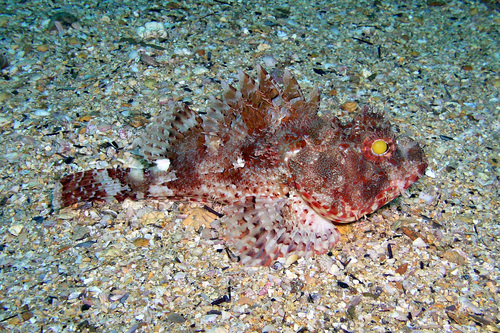
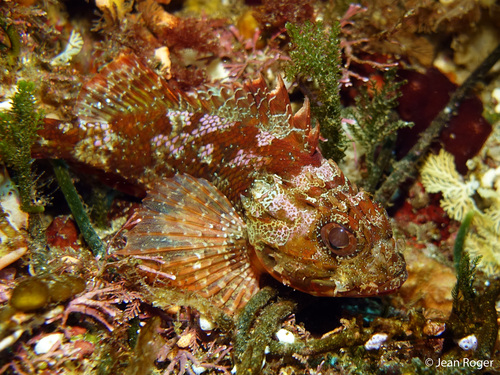
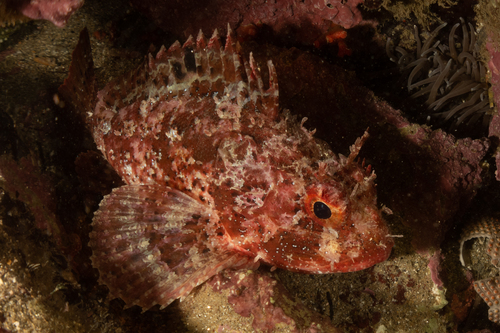
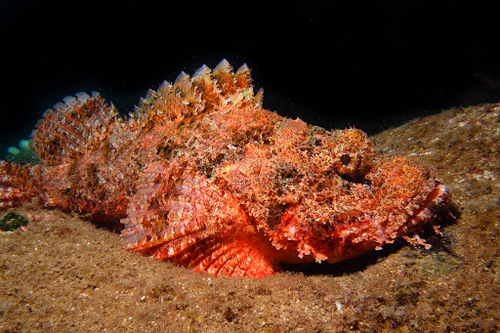
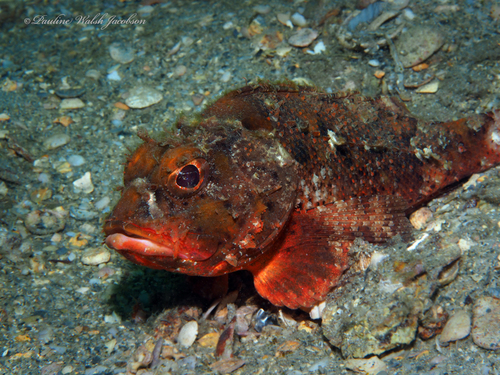
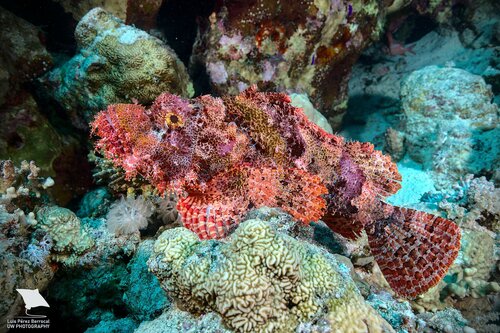
Description: Scorpaenopsis oxycephala has an elongated body that becomes compressed toward the rear, with a narrow intraorbital space. Its upper posttemporal and upper opercular spines are simple. The occipital pit is either absent or very shallow. This species has a very long snout, and adults grow numerous tentacles that form a beard around the mouth. Its dorsal fin has 12 spines and 9 soft rays, while its anal fin has 3 spines and 5 soft rays. In adults, the supraocular and postocular spines are broadly merged, with only the tip of the supraocular spine visible. These merged spines flare outward to form a ridge over the rear half of the eye. This species reaches a maximum published total length of 36 cm (14 in), making it the largest species in the genus Scorpaenopsis. This scorpionfish has mottled, variable reddish-brown patterning marked with white patches, and it often has a darker triangular area under the eye that extends backward over the cheek. Distribution and habitat: Scorpaenopsis oxycephala has a wide distribution across the Indo-Pacific. Its range stretches from the Red Sea south to Sodwana Bay in South Africa, through the Indian Ocean and Persian Gulf east to New Guinea, south to Australia, and north to Taiwan, and probably the Ryukyu Islands of southern Japan. It has also been reported from False Bay in South Africa. In Australian waters, it occurs on the Northwest Shelf off Western Australia, at Cartier Island in the Timor Sea, on the Great Barrier Reef off Queensland, and at Christmas Island. It inhabits reef slopes at depths between 1 and 35 meters.