About Scorpaenichthys marmoratus (Ayres, 1854)
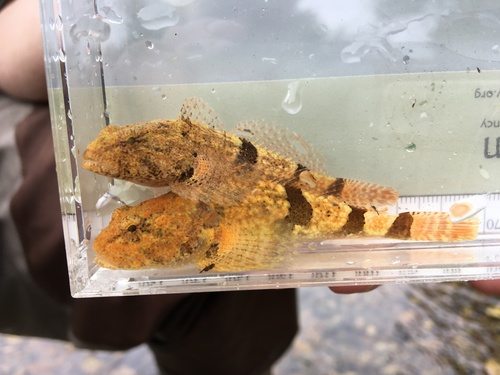
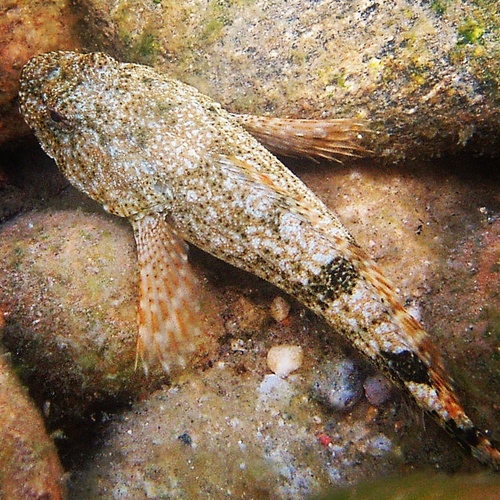
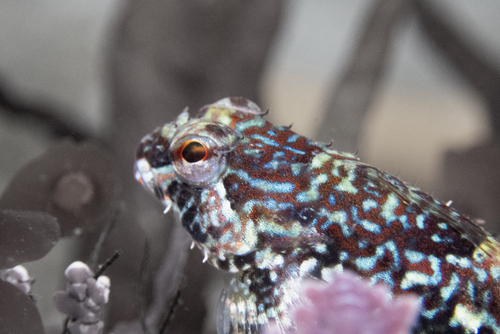
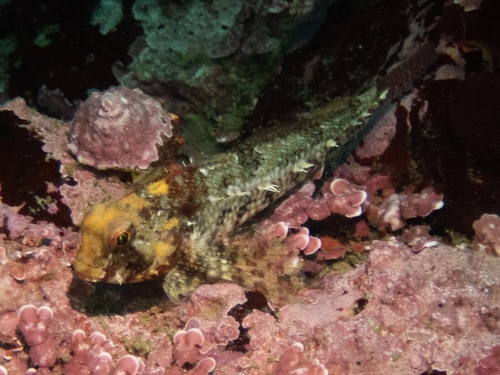
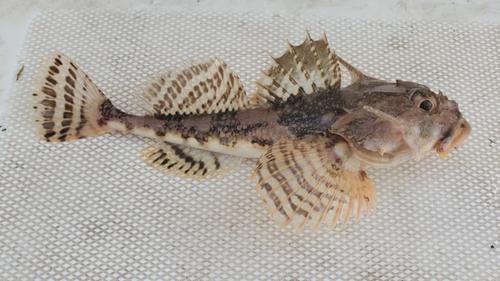
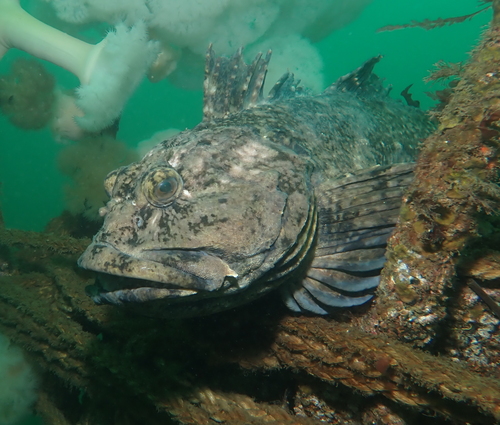
The cabezon (Scorpaenichthys marmoratus) is a scaleless fish with a broad, bony support that extends from the eye across the cheek just under the skin. It is the largest member of the sculpin superfamily Cottoidea, with no scales across its entire body. It has 11 spines on its dorsal fin, a stout spine positioned before the eye, an anal fin made up entirely of soft rays, and a fleshy flap on the middle of its snout. A pair of longer tentacle-like flaps called cirri sit just behind the eyes. Its mouth is broad and lined with many small teeth. Its coloration is variable, but generally mottled — as reflected by its species name marmoratus — in shades of brown, green, and red. Over 90% of red-colored cabezon are male, while over 90% of green-colored cabezon are female. The belly is typically pale turquoise or white. Cabezon kept in aquariums show some evidence that they can camouflage to match their surroundings. Like lingcod, which shares the cabezon's natural range, the cabezon's flesh and internal organs can be blue, a trait that depends on the fish's diet. Cabezon can reach up to 99 cm (3 ft 3 in) in length and 14 kg (31 lb) in weight; the largest recorded cabezon caught weighed 11.3 kg (24 lb 15 oz). As the Spanish-origin name cabezon implies, the fish has a very large head relative to its body. Cabezon are found in the northeast Pacific Ocean, ranging from Sitka, Alaska to Punta Abreojos, Baja California. Unlike rockfish and lingcod, which usually live on the sheer faces of rocky ledges, cabezon inhabit the tops of these features. They occupy a wide range of habitats at depths of 0–200 m (0–656 ft), including rocky, muddy, and sandy bottoms, and kelp beds. The ecological niche they occupy changes with their developmental stage. Newly hatched larvae live as plankton, typically in the upper layers of the water column. They are most often found in inshore waters, but can occur as far as 320 kilometres (200 mi) from the coast. Once larvae reach 40 mm (1.6 in) in length, the fish switch to a demersal lifestyle at depths between 6–12 m (20–39 ft). Adult cabezon have a relatively small home range and do not stray far from their nest sites. Their homing ability is linked to their sense of smell (olfaction). The vast majority of cabezon display site fidelity, meaning they return to locations they have occupied previously; this has been observed within a 100 m (330 ft) range along the coast of California. For cabezon, hatching occurs year-round, but hatching rates rise starting in February, peak in late March or early April, and drop sharply at the end of April or early May. Larvae are found in intertidal zones down to depths of 17 m, and are deposited on hard substrates including wood pilings, logs, rocks, and steel. They have been observed on exposed surfaces rather than under structures or fully submerged. Strong evidence confirms that sexually mature female cabezon spawn multiple times during a single spawning season. Warmer waters have a positive effect on female gonads, but have little to no effect on male gonads. Cabezon hatch as very small larvae around 5.8 mm (0.23 in) long. They grow to double their hatching size before continuing development to adulthood, where they reach an average weight of 17 lb (7.7 kg). Documented records show females are slightly larger and longer than males, but no evidence has been found to explain this size difference. Both sexes reach sexual maturity in their second or third year of life. Females can live up to 13 years, while males can live up to 9 years. It has been suggested that females live longer due to sexual dimorphism, but this claim is unsupported by evidence. The age of a cabezon is determined by counting growth rings on an ear bone called an otolith.