About Scorpaena cardinalis Solander & Richardson, 1842
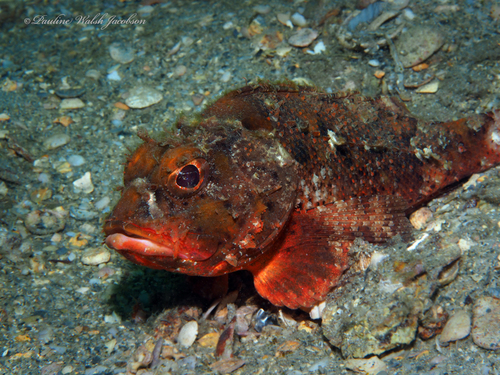
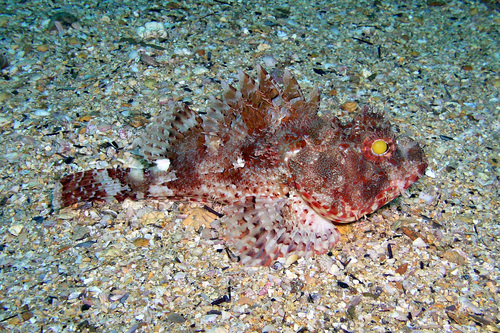
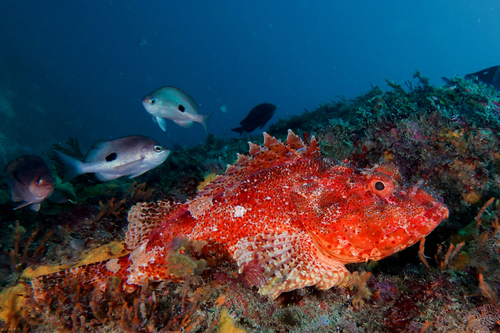
The body of Scorpaena cardinalis is laterally compressed, and this compression is more pronounced toward the posterior end. Numerous tentacles attach to the head of the fish. Its dorsal fin contains 12 toxic spines and 9 soft rays; the anal fin has 3 spines and 5 soft rays; the pelvic fin has 1 spine and 5 soft rays; and the caudal fin has 11 branched rays. The mouth is large and slightly oblique, and teeth are present on both the vomer and palatines. The underside of the jaw is smooth, with very few bumps or ridges. This species shows variation in both coloration and patterning. Individuals are typically pinkish-red or reddish-orange, and usually have brown spots. They become darker toward the posterior end of the body. This mottled coloration does not extend to the ventral side, as the species is bottom-dwelling. The maximum recorded total length for this species is 18 cm (7.1 in). Scorpaena cardinalis occurs in the temperate waters of the southwestern Pacific Ocean. In the waters around New Zealand, it is found from the Bay of Plenty northwards, as well as around the Kermadec Islands, Lord Howe Island, Middleton & Elizabeth Reefs, and Norfolk Island. It is replaced by S. jacksoniensis along the mainland coast of Australia. As a bottom-dwelling species, S. cardinalis uses cryptic coloration to avoid predation, and can change its coloration. It usually has skin flaps on its head and dorsal side that help it blend into the coral and rocky habitats it occupies. It lives in coral reefs and rockpools, and typically only moves when it is disturbed.