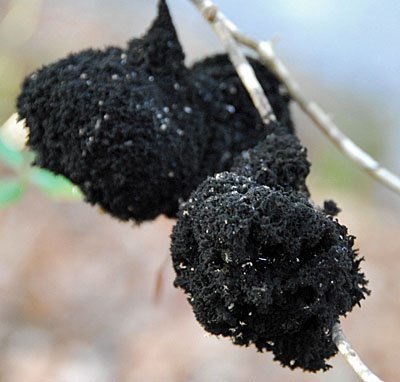
About Scorias spongiosa (Schwein.) Fr.
Scorias spongiosa (Schwein.) Fr. is a sooty mold fungus that grows on aphid honeydew. It belongs to the Capnodiaceae family of ascomycete fungi, and is found only on American beech trees (Fagus grandifolia).
Aphids accumulate in late summer and autumn, forming large colonies. Spores of Scorias spongiosa are carried by wind and rain, landing on the honeydew secretions left below aphid colonies. Initial hyphal growth is straw-colored and unpigmented. Hyphae adhere to each other over short distances, diverging and re-adhering to form a loose stranded structure. Pigmentation starts to develop on the surfaces of outer strands, and the stroma begins to darken. Hyphae coalesce to form mycelial strands that radiate outward and upward from the supporting structure.
Flask-shaped, spore-bearing pycnidia develop on the mycelia, which have a waxy texture: the fungus matrix changes from brittle to soft as it absorbs moisture. As more honeydew accumulates, the fungus grows larger until it looks like a gelatinous sponge resting on the branches or leaves of the beech tree. Fully pigmented strands in the mature stroma produce bowl-shaped pseudothecia, and the outermost hyphae stop growing. Inner strands continue growing and force their way outward. Asexual conidia are released in a slimy matrix inside liquid droplets from the pycnidia. Over time, the stroma becomes a spongy black mass and produces sexual spores called ascospores inside the pseudothecia, which stay embedded in the stroma.

