About Scopus umbretta Gmelin, 1789
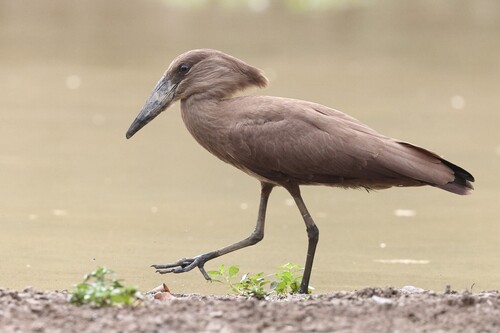
Description The hamerkop (scientific name: Scopus umbretta Gmelin, 1789) is a medium-sized waterbird. It stands 56 cm (22 in) tall and weighs around 470 g (17 oz), while the subspecies S. u. minor is smaller. Its plumage is drab brown, with purple iridescence on the back, and the subspecies S. u. minor is darker in overall color. Its tail has faint darker brown barring. The plumage and appearance of male and female hamerkops are identical, and fledglings look the same as adult birds.
The hamerkop has a long bill, measuring 80 to 85 mm (3.1–3.3 in), with a slight hook at the tip. It is similar to the shoebill's bill, quite compressed and thin, especially the lower half of the mandible. Young birds have brown bills, which turn black by the time the bird fledges.
Compared to other similar-looking Pelecaniformes, the hamerkop has proportionally shorter neck and legs. The bare parts of its legs are black, and feathers only grow up to the upper section of the tibia. For unknown reasons, the hamerkop has partially webbed feet. Its middle toe is pectinated (comb-like), just like a heron's middle toe. It has a short tail and large, wide, round-tipped wings that allow it to soar well, though it soars less often than shoebills or storks. When soaring, the hamerkop stretches its neck forward like a stork or ibis; when flapping its wings, it coils its neck back similar to a heron. When walking, its gait is jerky and rapid, and its head and neck move back and forth with each step. It may hold its wings out to get extra stability when running.
Distribution and habitat The hamerkop is distributed in Africa south of the Sahara, Madagascar, and coastal south-west Arabia. It needs shallow water to forage, and can be found in all wetland habitats, including rivers, streams, seasonal pools, estuaries, reservoirs, marshes, mangroves, and irrigated areas like rice paddies, as well as savannahs and forests. In Tanzania, it has recently started feeding on rocky shores. In Arabia, it inhabits rocky wadis with running water and trees. Most hamerkops are sedentary and stay within the territories held by pairs, but some only migrate into suitable habitat during the wet season. This species is highly tolerant of humans, and readily feeds and breeds in villages and other human-made habitats.
Behaviour and ecology The hamerkop is mostly active during the day, and often rests at midday during the hottest part of the day. It can be somewhat crepuscular, active around dusk, but contrary to some previous reports, it is not nocturnal.
Food and feeding This species usually feeds alone or in pairs, but it can sometimes feed in large flocks too. It is a generalist feeder: amphibians and fish make up the majority of its diet, and it also eats shrimp, insects, and rodents. The composition of its diet varies by location: in East and Southern Africa, clawed frogs and tadpoles are important parts of its diet, while in Mali, small fish are almost the only prey it takes. Because it accepts a wide range of food items including very small prey, it is not limited by resource availability and only needs to feed for part of the day.
Its common hunting method is walking in shallow water to look for prey. It locates prey differently depending on conditions: if the water is clear, it may hunt by sight; if the water is very muddy, it probes with its open bill into water or mud and then shuts it to catch prey. It may shuffle one foot at a time on the water bottom, or suddenly open its wings to flush prey out of hiding. Prey caught in mud is shaken to clean it before swallowing, or carried to clearer water to clean if that is available.
This species can also feed while in flight. A hamerkop flies slowly low over the water with its legs dangling and head facing down, then dips its feet down and hovers momentarily when it spots prey, before snatching the prey with its bill and swallowing it mid-flight. This hunting method can be very successful: in one 45-minute observation session, a single bird caught prey in 27 out of 33 attempts. It is also an opportunistic feeder, and will feed on swarming termites during their nuptial flights, catching up to 47 alates (flying termites) in five minutes.
This species has been recorded foraging for insects flushed out by grazing cattle and buffalo, similarly to how cattle egrets forage. It has also been observed fishing off the backs of hippopotamuses. It has also been recorded feeding alongside banded mongooses: when a group of mongooses hunted frogs in dried mud at the edge of a pool, a pair of hamerkops stayed with the feeding group to catch frogs that escaped the mongooses.

