About Scophthalmus rhombus (Linnaeus, 1758)
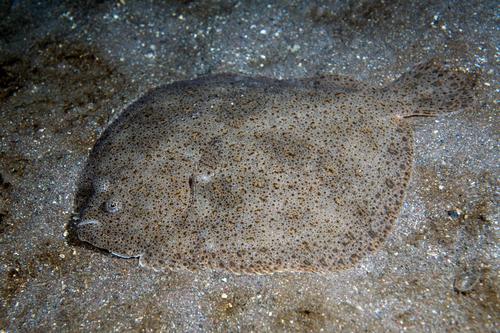
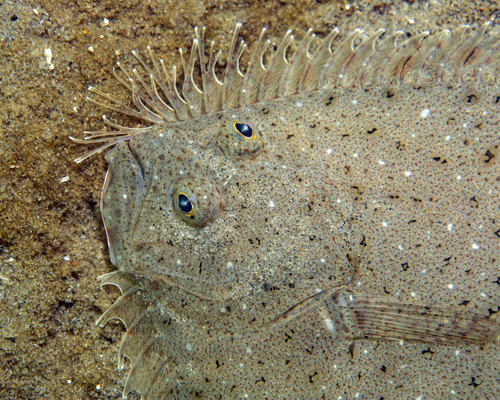
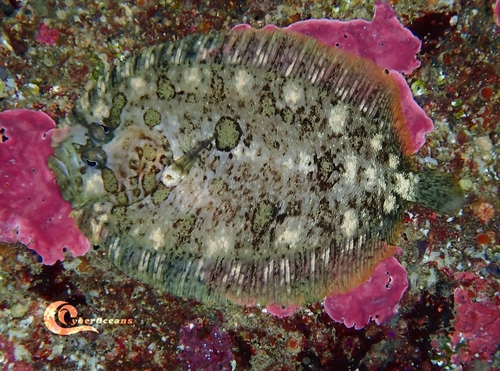
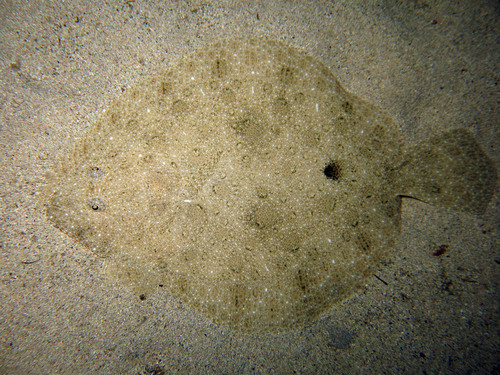
The brill (Scophthalmus rhombus) is a flatfish species that belongs to the turbot family Scophthalmidae, in the order Pleuronectiformes. This fish is found in the northeast Atlantic, Black Sea, Baltic Sea, and Mediterranean, and it primarily occupies deeper offshore waters. Brill can live in shallow waters, and can also be found on the seafloor at depths below 100 meters. It prefers to live on either sandy or muddy substrate, depending on its location. Brill have slender bodies, with brown bodies covered in lighter and darker flecks that do not extend to the tailfin; the underside of the brill is usually cream or pinkish white. Like other flatfish, brill can change their color to match their surrounding environment. On average, brill live 6 years, can weigh up to 8 kg (18 lb), and can reach a maximum length of 75 cm (2 ft 6 in), though the average individual is less than half that maximum length. A portion of the brill's dorsal fin is not connected to the fin membrane, which gives the fin a frilly appearance. Brill are sometimes confused with turbot (Scophthalmus maximus), which has a more diamond-shaped body. These two related species can interbreed and produce hybrids. On the west coast of Canada, which is outside the native range of Scophthalmus rhombus, local fishermen call the petrale sole Eopsetta jordani brill. Compared to turbot, brill flesh has a lighter texture, is more friable (even described as "floury"), and has a much milder flavor, so chefs generally prefer turbot.