About Scomberomorus maculatus (Mitchill, 1815)
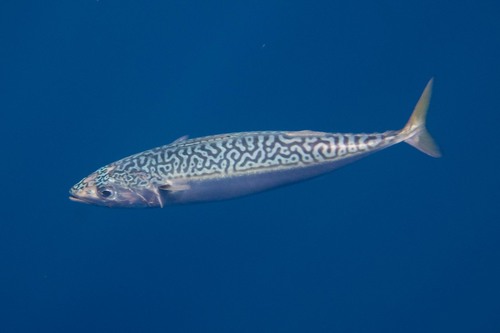
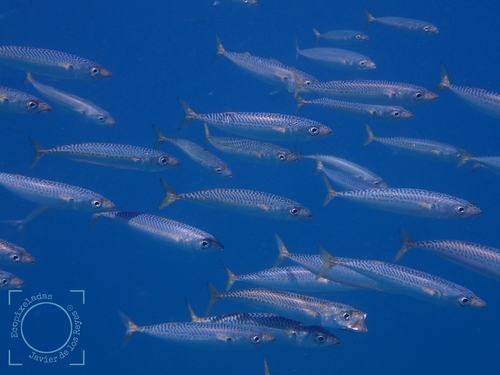
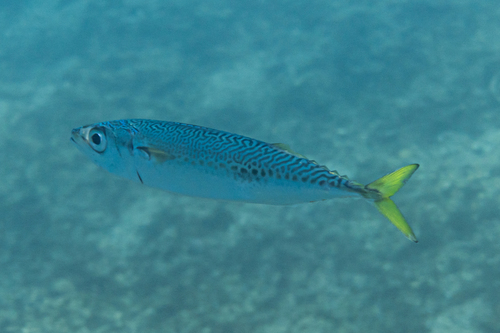
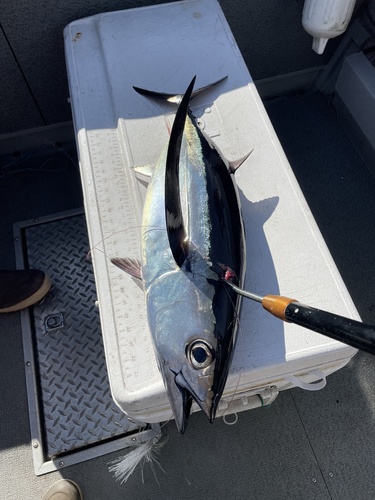
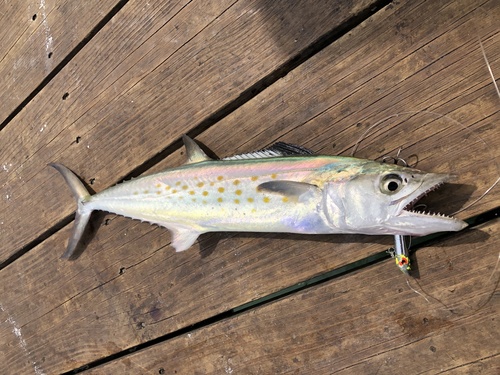
This species, Scomberomorus maculatus, commonly known as Spanish mackerel, has a green back and silvery sides marked with around three rows of round to elliptical yellow spots. Its lateral line gradually curves downward from the upper end of the gill cover toward the caudal peduncle. The first, spiny dorsal fin is black at the front, while its posterior membranes are white with a black edge. Each jaw holds a single row of cutting-edged teeth, with around 64 teeth total: these teeth are large, uniform, closely spaced, and flattened from side to side. Like the teeth of king mackerel and cero mackerel, these teeth are very similar in appearance to the teeth of bluefish, Pomatomus saltatrix. Spanish mackerel can very rarely grow to 37 inches (940 mm) long and reach a maximum weight of 14 pounds (6.4 kg). Spanish mackerel occur seasonally along the western Atlantic coast, ranging from the Yucatán Peninsula, Mexico as far north as Cape Cod, Massachusetts. They are a shallow-water species that prefers sandy bottoms at depths between 10 and 40 feet (3 to 12 m), and are occasionally found as deep as 80 feet (24 m). Commercially caught Spanish mackerel are too small to be sold as steaks, so they are primarily marketed fresh or frozen as fillets. Their raw flesh is white. They can be prepared by broiling, frying, baking, or more rarely by smoking. Spanish mackerel is also a popular sushi fish. By analogy with Japanese Spanish mackerel, another member of the same genus, it is often labeled sawara on sushi menus.