About Scomberomorus commerson (Lacepède, 1800)
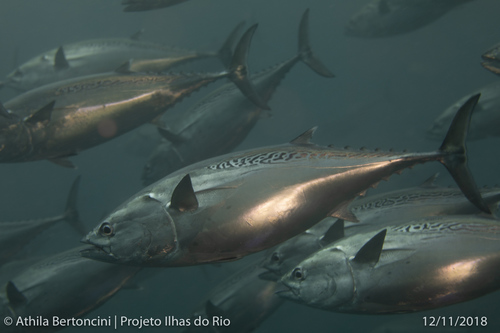
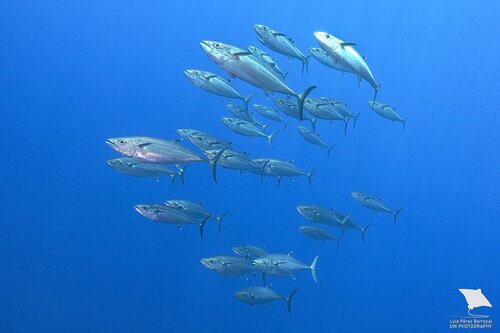
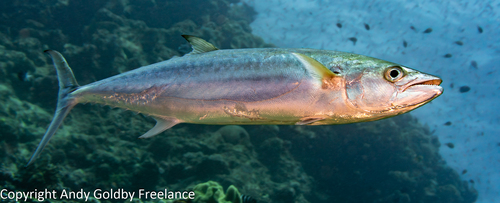
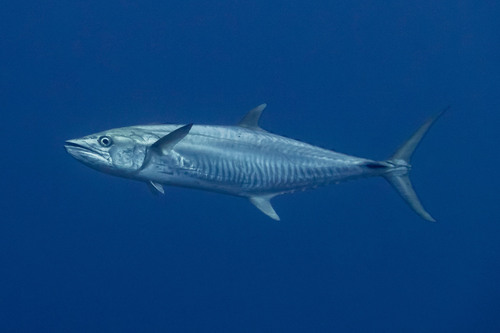
This species, Scomberomorus commerson, also called Spanish mackerel, has vivid blue to dark grey colouration along its backs and flanks, fading to a silvery blue-grey on the belly. Scores of narrow vertical lines run down its sides. It can grow to around 200 cm in length and reach up to 70 kg in weight, and is the largest of all Australian mackerels. Scomberomorus commerson has a wide distribution centered on Southeast Asia. It ranges west to the east coast of Africa, occurs across the Persian Gulf and along the northern coastal areas of the Indian Ocean, and extends east to Fiji in the South West Pacific. It is common along both coasts of Australia, reaching as far south as Perth on the west coast and Sydney on the east coast. It can also be found as far north as China and even Japan. It was first recorded in the Mediterranean Sea in 1935 off Mandatory Palestine, and is now very common in the eastern Levant, where it has become an important target species for local fisheries. Spanish mackerel spawn in oceanic conditions along reef edges. Their eggs have a large oil droplet that aids buoyancy, keeping the eggs in the upper, warmer, well-oxygenated water column that holds abundant planktonic food for newly hatched larvae. Larval Spanish mackerel are believed to stay in species-specific groups, and are not normally found with other species of the same genus, such as S. semifasciatus and S. queenslandicus. This separation does not always hold for adult mackerel, which may occasionally mix with other species within the same genus. Spawning is seasonal, and the spawning season is extended in the warm tropical waters. Many fisheries targeting this species focus on prespawning feeding aggregations. A significant proportion of female Spanish mackerel caught in Northern Territory waters between July and December are either recently spawned or close to spawning. In general, spawning occurs when water temperatures are higher, conditions that promote optimal food availability to support the rapid growth and development of larvae. As young larvae grow, they move from offshore spawning grounds to inshore and estuarine habitats, where they stay during the juvenile phase of their growth cycle. In these inshore environments, juvenile Spanish mackerel feed mostly on the larvae and juveniles of small fish and crustaceans, until they grow large enough to eat small fish and squid. Australian studies of this species indicate that females are larger than males. Female Spanish mackerel reach sexual maturity at around two years of age, or at roughly 80 cm in length.