About Scomberomorus cavalla (Cuvier, 1829)
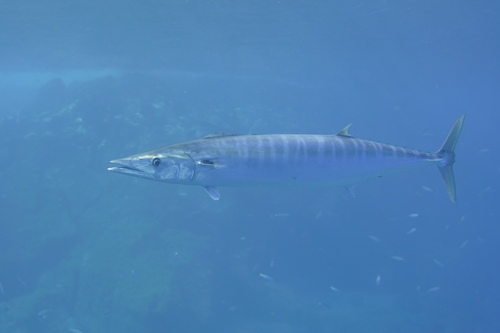
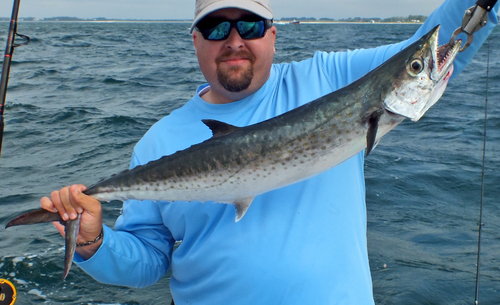
King mackerel, scientifically named Scomberomorus cavalla (Cuvier, 1829), is a medium-sized fish. Most individuals weigh between 5 kg (11 lb) and 14 kg (30 lb), but specimens have been recorded weighing over 40 kg (90 lb). Its entire body is covered with very small, loosely attached scales that are barely visible to the naked eye. The first spiny dorsal fin is entirely colorless, and it normally folds back into a body groove, just like the pelvic fins. The lateral line originates high on the shoulder, dips abruptly at the mid-point of the body, then continues as a wavy horizontal line all the way to the tail. Its back is colored olive, which fades to silver with rosy iridescence on the sides, and fades further to white on the belly. Fish weighing less than 5 kg (11 lb) have yellowish-brown spots on their flanks; these spots are somewhat smaller than the spots found on the Atlantic Spanish mackerel, Scomberomorus maculatus. Its cutting-edged teeth are large, uniform, closely spaced, and flattened from side to side. These teeth closely resemble those of the bluefish, Pomatomus saltatrix. King mackerel is a subtropical species that occurs along the Atlantic Coast of the Americas. It is common in the coastal zone from North Carolina to Brazil, reaches as far south as Rio de Janeiro, and occasionally ranges as far north as the Gulf of Maine. It is also found off the coasts of India: predominantly in the Arabian Sea on India's western coast, and in the Bay of Bengal on India's eastern coast in the Indian Ocean. Its preference for water temperatures between 20 and 29 °C (68 to 84 °F) may limit its overall distribution. Most king mackerel live at depths of 12–45 m (40–150 ft), which is where the main commercial king mackerel fisheries operate. Larger king mackerel that weigh more than 9 kg (20 lb) are often found inshore, in the mouths of inlets and harbors, and occasionally even at depths of 180 m (590 ft) at the edge of the Gulf Stream.