About Scomberoides commersonnianus Lacepède, 1801
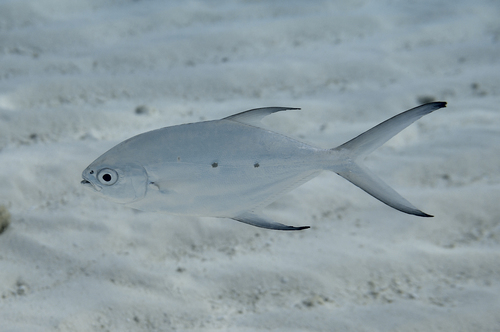
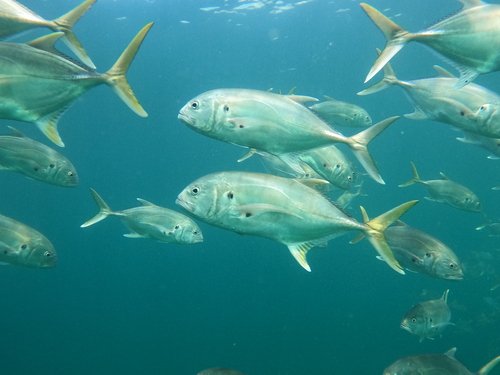
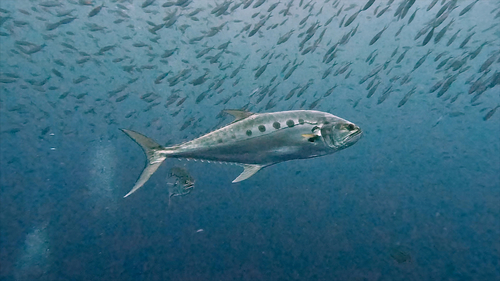
Scomberoides commersonnianus Lacepède, 1801 has a single row of 5 to 6 large dark silvery spots or blotches running along its flanks, over the lateral line. It does not have a dark tip on its dorsal fin lobe. Its snout is rather blunt, and its large mouth holds several rows of very sharp teeth. Both the anal fin and dorsal fin are truncated, with the posterior part of each fin reduced to spines. The caudal fin is strongly forked. The head and back are bluish grey, while the ventral side of the body is silvery. This species reaches a maximum total length of 120 centimetres (47 in), though individuals more commonly grow to 90 centimetres (35 in). The maximum published weight for Scomberoides commersonnianus is 16 kilograms (35 lb).
Scomberoides commersonnianus has a wide distribution in the Indian Ocean and western Pacific Ocean. It occurs from South Africa, the Red Sea, and the Persian Gulf in the west, east through Indonesia and Papua New Guinea as far as New Caledonia, north to southern Japan, and south to Western Australia and New South Wales.
Adult Scomberoides commersonnianus live in coastal waters, and are frequently found near reefs and offshore islands. They occasionally enter estuarine waters, and are normally found in small schools. Adults are predatory, feeding on fishes, cephalopods, small invertebrates, and other pelagic prey. Juveniles use their rasping teeth to feed on the scales and epidermis of other fishes. This species grows rapidly during early life, with growth slowing later on: it reaches 25 cm in its first year, and 50 cm by its third year. Females reach sexual maturity when they attain a fork length of 63 centimetres (25 in), at around 4 to 5 years old. Spawning occurs from August to March in Australia, and between March and June in the Persian Gulf. The fecundity of mature females is estimated at 259,488 to 2,859,935 eggs per spawning event.