About Scomberesox saurus (Walbaum, 1792)
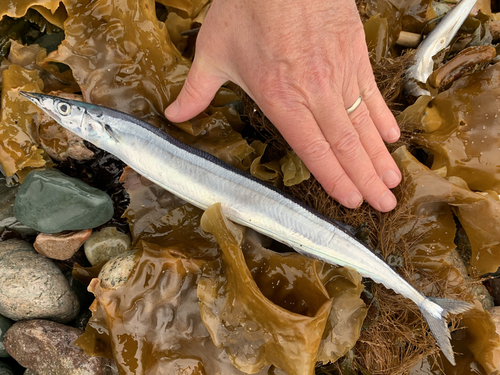
This fish species, Atlantic saury (Scomberesox saurus), has an elongated, slender body with very long, beak-like jaws that bear minute teeth. It typically grows to about 35 cm (14 in) long, with a maximum recorded length of 50 cm (20 in). It has a row of small finlets behind both its dorsal and anal fins. It resembles garfish in general appearance, but can be distinguished by its much smaller teeth. Atlantic saury live near the water surface, and often jump above the surface. The species is native to the northern Atlantic Ocean, found off the coast of North America from the Gulf of Saint Lawrence to North Carolina and Bermuda, and off the coast of Western Europe. It has occasionally been recorded as far north as Iceland, Norway, Denmark, the British Isles, and the Baltic Sea, but its main range lies further south in the Atlantic, including the Mediterranean Sea (the Adriatic and Aegean Seas) and the coasts of Tunisia and Morocco. It occurs from the surface down to depths of around 30 m (100 ft). When one was caught off the coast of Pembrokeshire in 1904, the species was not recognized as a British fish; however, as sea temperatures have warmed, it has been expanding its range northward. Atlantic saury are gregarious fish that feed on zooplankton and fish larvae, and are preyed on by tuna, marlin, bluefish, and cod. This is a migratory species: it moves inshore during the summer, and returns to deeper water later in the year. Spawning occurs near the surface in the open sea. The eggs have filaments attached and are pelagic. Juveniles live in tropical mid-oceanic waters; their jaws are relatively short when young, and elongate as they grow.

