About Scomber scombrus Linnaeus, 1758
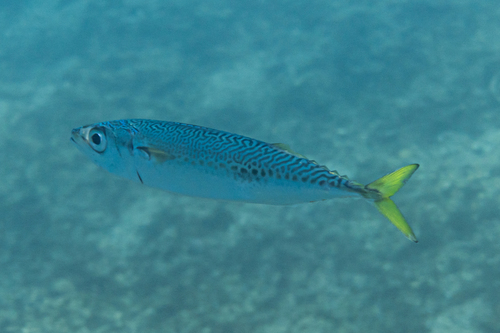
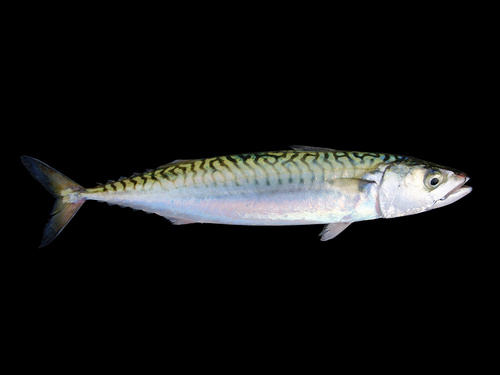
Atlantic mackerel, scientifically named Scomber scombrus Linnaeus, 1758, has an elongated, fusiform body with a long, pointed snout. It has large eyes covered by an adipose eyelid, and small, sharp, conical teeth. Most of its scales are small, with the only exceptions being scales immediately behind the head and around the pectoral fins; these small scales give the fish a velvet-like texture. The two large dorsal fins are spaced far apart. The second dorsal fin is typically followed by 5 dorsal finlets, though this number can range from 4 to 6. The anal fin originates slightly behind the second dorsal fin, matches it in size and shape, and is also followed by 5 finlets. The body tapers into a slender caudal peduncle, where the short, broad tail fin attaches. The upper (dorsal) part of the body is steel-blue, with wavy black lines running perpendicular to the fish's length. The rest of the body ranges from silvery-white to yellow, and may have darker splotches. This species can grow up to 60 cm (24 in) in total length, with a common adult length of 30 cm (12 in). The maximum published weight for an Atlantic mackerel is 3.4 kg (7.5 lb).
The native range of Atlantic mackerel extends from Labrador, Canada to Cape Lookout, North Carolina in the western Atlantic. In the eastern Atlantic, it occurs from Iceland and Norway south to Mauritania, and is also present in the Mediterranean, Black, and Baltic Seas. Its overall range spans from 70°N to 25°N latitude, and 77°W to 42°E longitude. Atlantic mackerel prefer water temperatures above 8 °C (46 °F), but they are commonly found in waters as cold as 7 °C (45 °F), and have rarely been recorded in waters as cold as 4.5 °C (40.1 °F). They most commonly occur from the ocean surface down to 200 m (660 ft), but individual fish have been found as deep as 1,000 m (3,300 ft). Atlantic mackerel are migratory: they stay closer to shore, between 32 and 161 km (20 to 100 mi) offshore, during spring and summer. Juveniles move closer to shore than adults, and occasionally juveniles will even enter harbors. In fall and winter, they move further offshore and further south to warmer waters on the edge of the continental shelf. In North America, they first arrive at coastal areas in April at the southern end of their range, and are present along the entire coast of their range by July. They begin moving back offshore in September, and are completely absent from coastal areas by December. Food availability rises sharply over the summer, and the fish reach their peak fat tissue mass in August, just four months after their annual low in April.
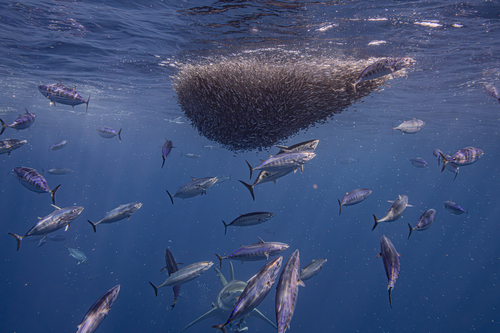
Atlantic mackerel are active, fast-swimming fish that must stay in constant motion to obtain enough oxygen to survive. They swim using short movements of their rear body and caudal fin. Unlike other mackerel species, Atlantic mackerel do not leap out of water unless they are trying to escape a predator. They form large schools of similarly-sized individuals near the ocean surface during all seasons except winter. Because larger fish have a higher ratio of muscle mass to surface area, schools made up of larger fish can swim faster than schools of smaller individuals.
For human consumption, Atlantic mackerel has red outer meat and white inner meat, with a strong flavor that some consumers find desirable. It is sold fresh, frozen, smoked, salted, as fillets, or as steaks. The fish is very high in oil content, vitamin B6, vitamin B12, selenium, niacin, and omega-3 fatty acids, containing nearly twice as much omega-3 per unit of weight as salmon. Unlike king mackerel and Spanish mackerel, North Atlantic mackerel have very low mercury levels, and United States Environmental Protection Agency guidelines state that this fish can be safely eaten at least twice per week.