About Scomber japonicus Houttuyn, 1782
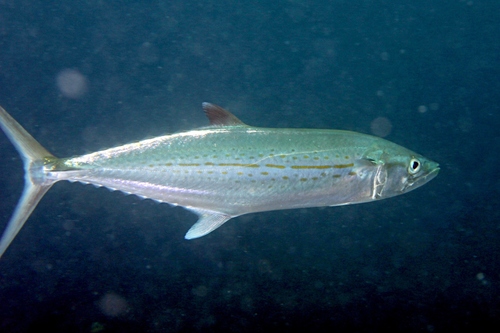
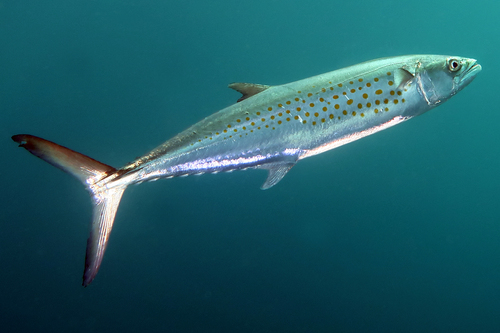
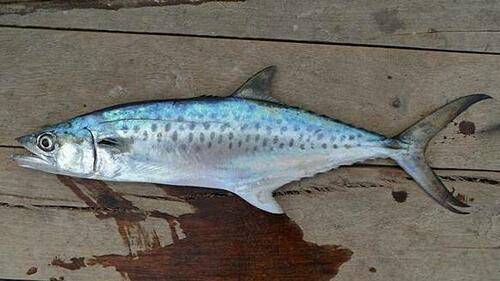
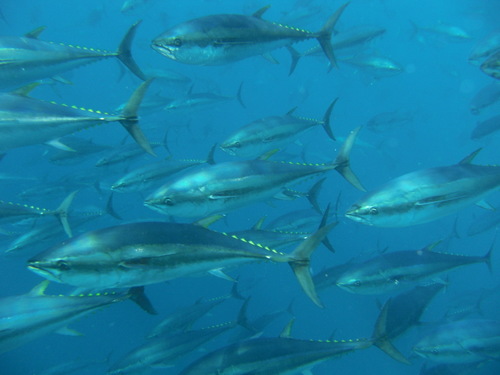
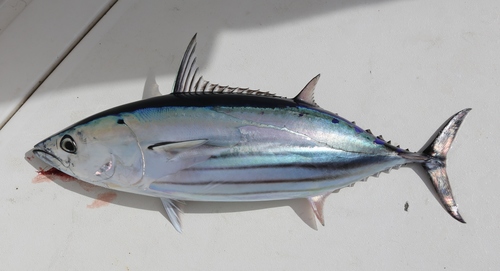
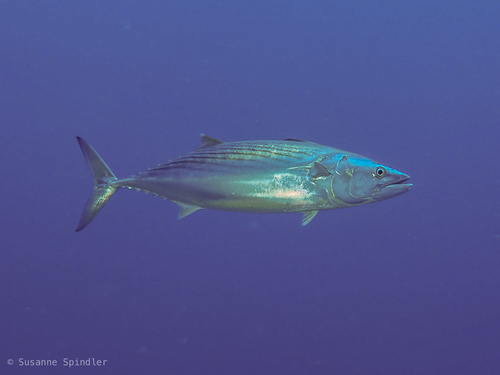
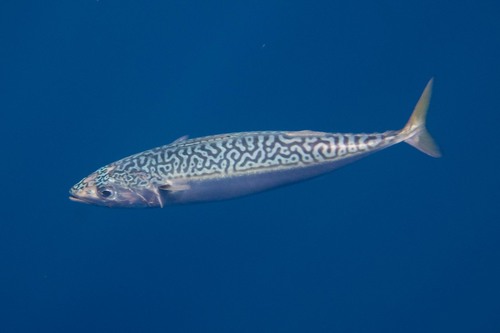
Chub mackerel (Scomber japonicus Houttuyn, 1782) has several distinct characteristics. It has a well-developed swim bladder attached to the esophagus, a feature that true mackerels in the genus Scomber do not have. There are clear visible differences between chub mackerel and Atlantic chub mackerel. Atlantic chub mackerel has silvery sides below the midline, while the lower sides of chub mackerel (which is otherwise similar in color to Atlantic chub mackerel) are mottled with small dusky blotches. Chub mackerel also has a larger eye than Atlantic chub mackerel. Less noticeable differences include that the dorsal fins of chub mackerel are positioned closer together, and its first dorsal fin has only 9 or 10 spines, while Atlantic mackerel usually has 11 or more spines. Like most mackerel species, chub mackerel travels in large schools. It is smaller than its more well-known relatives, reaching a total length of around 8 to 14 inches (20 to 36 cm). Chub mackerel is widespread across the Indo-Pacific. It is largely absent from the Indian Ocean, with the exception of a small range in South Africa stretching from KwaZulu-Natal to Western Cape. In the Atlantic Ocean, chub mackerel is replaced by the closely related Atlantic chub mackerel. It is widely distributed across the northwestern, southeastern, and northeastern Pacific Ocean. In the eastern Pacific, its range extends from Southeast Alaska to central Mexico. Chub mackerel is generally found within 20 miles (32 km) of the coast, in water temperatures between 50 and 72 °F (10 and 22 °C). Young chub mackerel live around sandy beaches or kelp beds, while adults live in deeper waters on shallow banks down to 1,000 feet (300 m) deep. Chub mackerel forms mixed schools with other pelagic species, including other types of mackerel and sardines. In 2015, a new mackerel species, Scomber indicus, was discovered in the Indian Ocean. Nutrition specialists consider chub mackerel a healthy food. It is high in protein, and rich in omega-3 and unsaturated fatty acids. Due to its high energy and protein content, and low carbohydrate level, it is recommended for the diets of growing children and pregnant women, though it may contain high levels of heavy metals. Chub mackerel is a popular ingredient in Sicilian cuisine, where it is prepared in many different ways. In Sicilian, the fish has several local names: strummu ucchiutu, varatulu scrummu, and occhiutu. In markets and kitchens, the fish is at its best when its flesh is firm, eyes are clear, and its colors are bright. It is most commonly eaten fresh, but it may also be sold pickled or frozen. In Sicilian cuisine, it is also served filleted and raw, marinated in oil, lemon, salt, and pepper. Jorim is a Korean dish made with tofu, vegetables, meat, and seafood, and chub mackerel is one of the most popular ingredients used for mackerel jorim among Koreans.