About Scolymus maculatus L.
Scolymus maculatus L. is a spiny herbaceous plant that can be annual, biennial, or perennial, growing up to 1.5 metres (5 ft) high. Its stems have uninterrupted spiny wings running along their entire length. The leaves are wavy, roughly oval in shape, mostly 9–14 centimetres (3+1⁄2–5+1⁄2 in) long. They have prominent white veins, are pinnately divided, arranged alternately along stems, have toothed margins tipped with spines, and a white vein that outlines the entire leaf. This plant contains milky latex and has 20 chromosomes (2n=20).
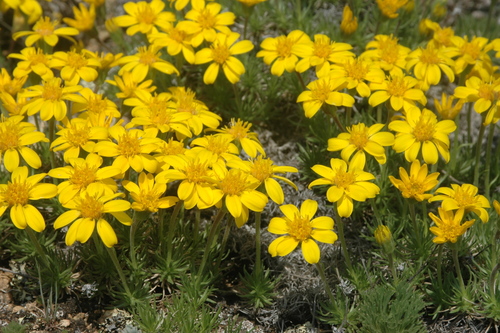
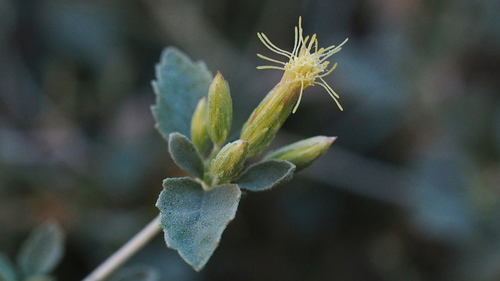
Roundish flower heads grow at the tip of the stem. Each flower head is subtended by an involucre made of multiple rows of more than five spine-tipped bracts, which measure 11 to 18 millimetres (3⁄8 and 3⁄4 in) long. Inner bracts are leaf-like, while outer bracts are short, thin, and have a white margin. The shared receptacle (floral base) is 7–11 mm (1⁄4–3⁄8 in) in diameter, conical in shape, and covered in oval papery bracts called chaff or paleae. Dorsally compressed cypselas are set into the receptacle, each enclosed by a palea, with outer rows of cypselas sitting higher than inner rows. No pappus bristles are present on the tips of the cypselas. The yellow strap-shaped corolla is 17–24 mm (5⁄8–1 in) long, ends in five teeth, and has black hairs on its tube.
Like all species in the Asteraceae family, Scolymus maculatus has pentameric flowers with fused anthers that form a tube, through which the style grows. The style collects pollen on hairs along its length, and splits into two style branches at its tip. These structures sit on an inferior ovary that develops into an indehiscent, single-seed fruit called a cypsela. All florets are arranged on a common receptacle, and surrounded by an involucre of multiple rows of bracts. Golden thistles belong to the Cichorieae tribe, which shares anastomosing latex canals in roots, stems, and leaves, and has flower heads made up of only one type of floret. In the genus Scolymus, all florets are ligulate, which is typical for this tribe except for Warionia and Gundelia, which only have disk florets. Within Cichorieae, Scolymus can be uniquely distinguished by its dorsally compressed cypselas, which are each surrounded by scales (paleae).
Scolymus maculatus naturally occurs in the Canary Islands, Madeira, and along the Mediterranean region. Confirmed locations include: Portugal; Spain (including the Balearic Islands); France (coastal Languedoc-Roussillon region, and the departments of Vaucluse, Lot, Bas-Rhin, and Somme); Italy (Sicily, Sardinia, Tuscany, Lazio, Campania, Basilicata, Calabria, Apulia, Molise, and Abruzzo); Malta; Greece; Cyprus; Turkey; Lebanon; Syria; Iraq; Israel; Egypt; Tunisia; Algeria; and Morocco.
It is a nitrophilous plant that prefers deep, rich, disturbed clayey soils in full sun or light shade, in habitats such as fallowed or abandoned fields, ditches, and roadsides. It generally grows below 700 m (2,300 ft) altitude near coasts, where there are fewer than 15 frost days per year. In Israel, it can be found in woodlands, shrublands, steppes, deserts, and montane vegetation on Mount Hermon. Flowers bloom between May and August. The flowers are hermaphrodite and pollinated by insects.