About Scolopsis margaritifera (Cuvier, 1830)
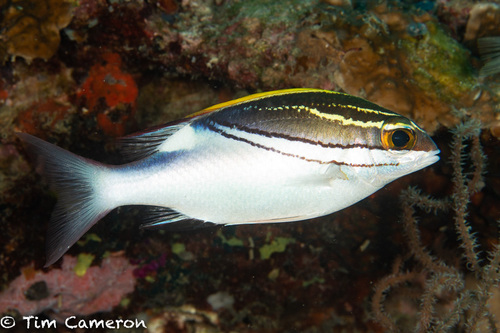
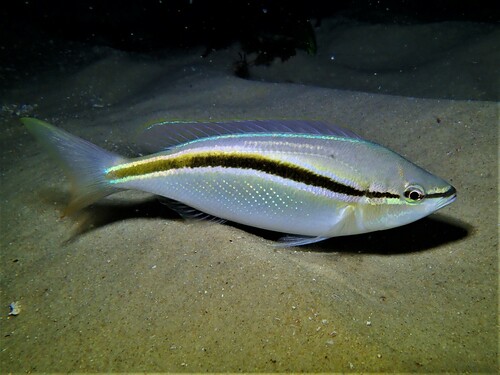
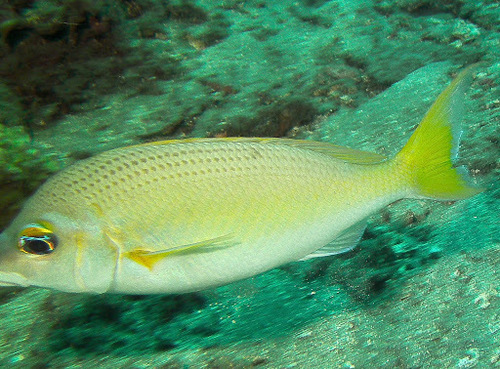
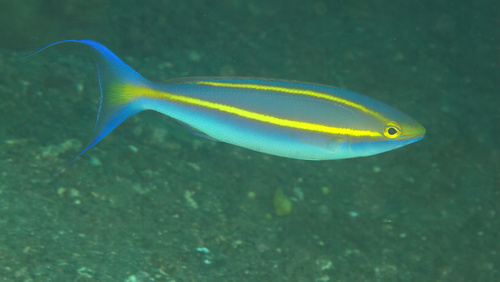
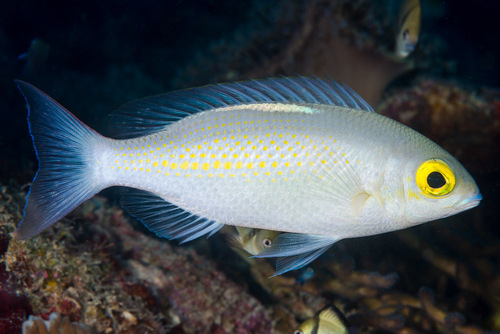
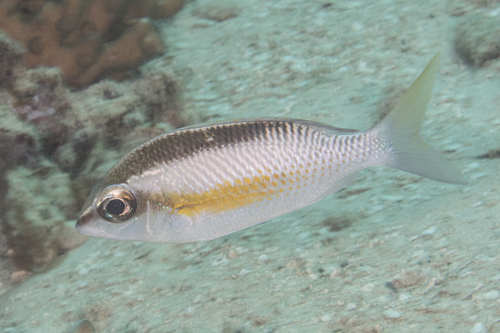
Scolopsis margaritifera, also known as Scolopsis margaritifera (Cuvier, 1830), has a dorsal fin supported by 10 spines and 7 soft rays, while its anal fin contains 3 spines and 7 soft rays. The body depth of this species is between 2.4 and 3.8 times its standard length, and the snout is shorter than the diameter of the eye. Scales on the head extend forward to or nearly to the rear nostrils, and scales are present on the lower limb of the preoperculum. There is no forward-pointing spine located underneath the eye. The pelvic fins are long, and extend to or just beyond the level where the anal fin originates. The caudal fin is forked. Adult Scolopsis margaritifera are olive-colored on the back and paler on the lower part of the body. Body scales bear silvery marks, and scales on the flanks have yellow spots that form horizontal lines. A bluish line runs across the snout in front of the eyes. Juveniles are pale overall with a darker back, a black longitudinal stripe along the flanks, and sometimes have a yellow lower body. The maximum published total length for this species is 28 cm (11 in), though a 15 cm (5.9 in) standard length is more typical. Scolopsis margaritifera occurs from the Andaman Sea in the eastern Indian Ocean eastward to Vanuatu, south to northeastern Australia, and north to Taiwan. It has also been recorded in Palau, Eauripik, Ulithi, and the Ryukyu Islands. This benthic fish inhabits depths between 2 and 25 m (6 ft 7 in and 82 ft 0 in), and lives in sandy seabed areas near reefs.