About Scolopsis ciliata (Lacepède, 1802)
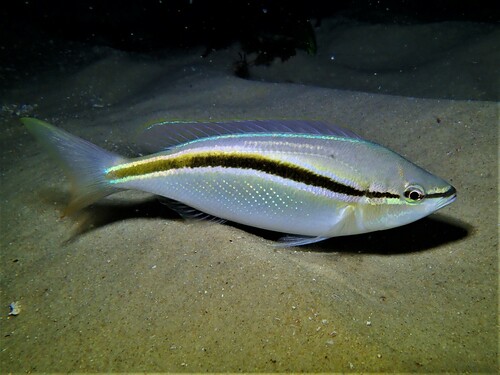
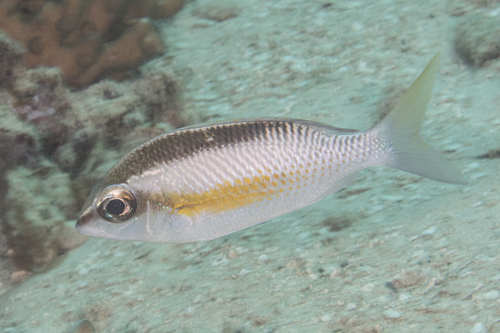
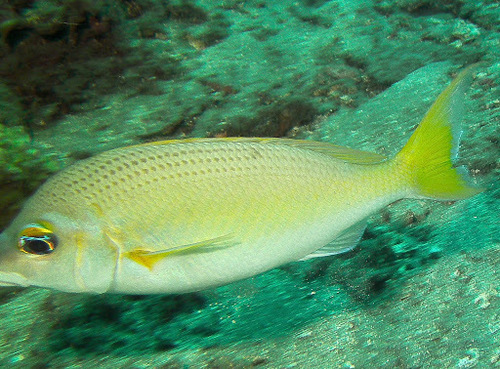
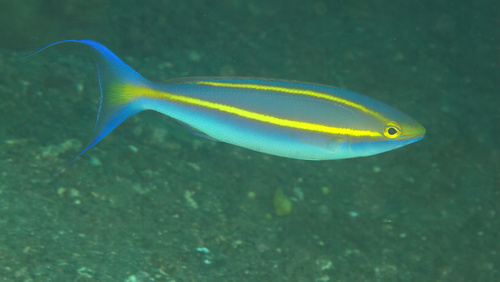
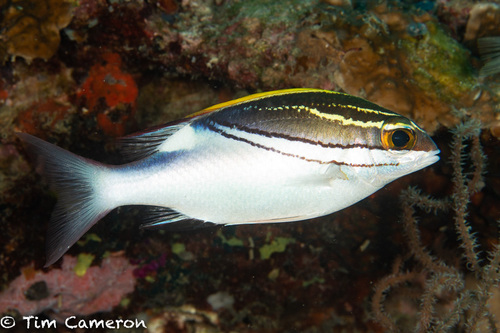
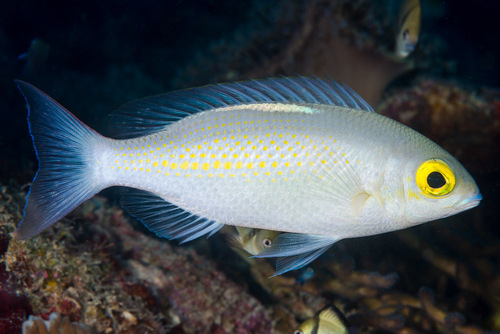
Scolopsis ciliata, formally described by Lacepède in 1802, has 10 spines and 7 soft rays supporting its dorsal fin, while its anal fin contains 3 spines and 7 soft rays. The depth of its body is between one third and one 3.4th of its standard length, and the snout is slightly shorter than the eye diameter. Scales on the head extend forward to or just past the front nostrils, and scales are also present on the lower limb of the preoperculum. A forward-pointing spine sits underneath the eye. The pelvic fins are long, reaching to or just beyond the level of the anus, and the caudal fin is forked. Its body background color is olive on the back and white on the lower body, with a white stripe running underneath the dorsal fin. A band of yellow spots runs along the flanks, starting at the pectoral fin and ending at the caudal peduncle. The upper and lower margins of the caudal fin are occasionally reddish. The maximum published total length of this species is 25 cm (9.8 in), though a standard length of 10 cm (3.9 in) is more typical. Scolopsis ciliata occurs from the Andaman Sea in the eastern Indian Ocean eastward into the Western Pacific Ocean, reaching as far east as New Caledonia and Vanuatu, and as far north as the Ryukyu Islands. There is also an unpublished record of this species from Wallis Island. It inhabits depths between 2 and 25 m (6 ft 7 in and 82 ft 0 in), and can be found on sandy substrates near coral reefs, close to mangroves, and in silty areas with low visibility. It is often found in groups and feeds on smaller fishes and benthic invertebrates.