About Scolopsis bilineata (Bloch, 1793)
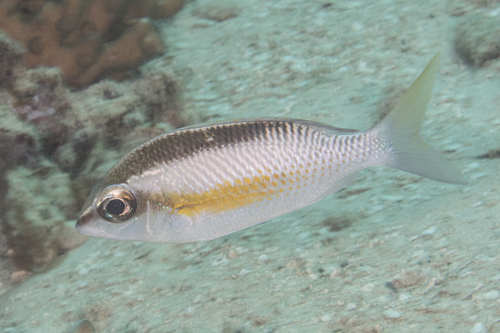
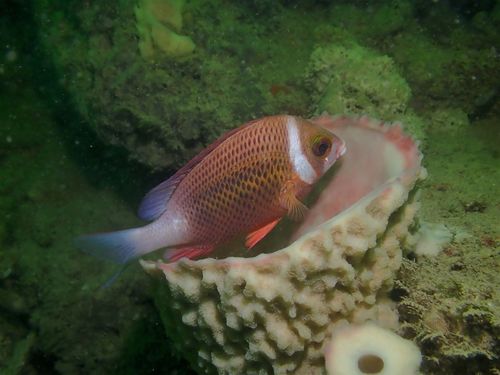
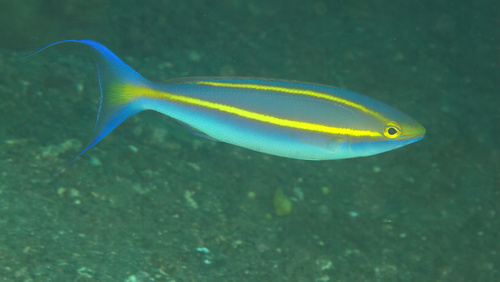
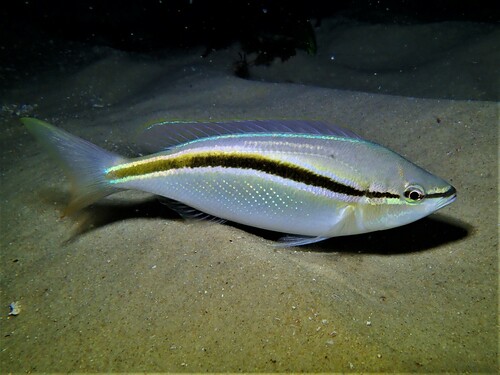
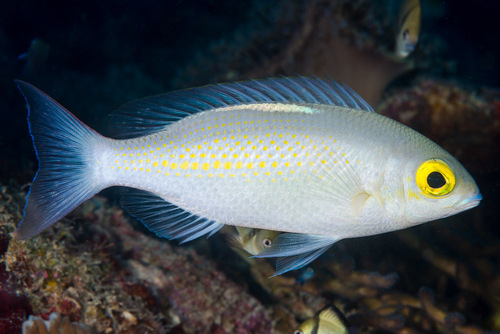
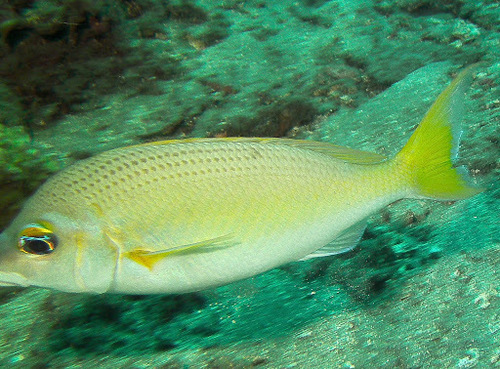
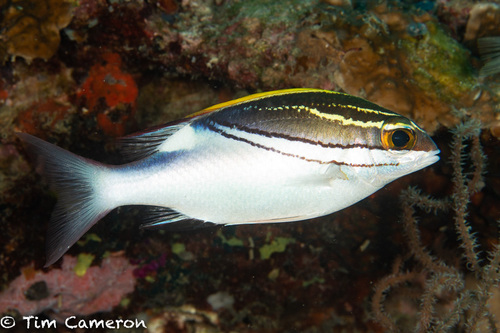
Scolopsis bilineata has a dorsal fin supported by 10 spines and 7 soft rays, and an anal fin with 3 spines and 7 soft rays. Its standard length measures 2.5 to 3 times its body depth, and its snout is shorter than the diameter of its eye. The pelvic fins are long, reaching or almost reaching the origin of the anal fin, and the caudal fin is forked. Adult individuals of this species have a black-margined white stripe that curves upward from below the eye to the center of the dorsal fin base, plus a pair of white lines located above and behind the eyes. The spiny section of the dorsal fin is yellow, and there is a white patch on the back below the soft-rayed portion of the dorsal fin. Juveniles have distinct different coloration and patterning: the upper half of a juvenile's body is black with two yellow stripes, the middle of the flanks has a wide, poorly defined white stripe, and there is a prominent black marking on the dorsal fin. This species reaches a maximum published total length of 25 cm (9.8 in), while a 13 cm (5.1 in) standard length is more common. Scolopsis bilineata occurs in the eastern Indian Ocean and western Pacific Ocean. Its range extends west to the Maldives and Sri Lanka, east to Fiji, the Caroline Islands and Tonga, north to the Ryukyu Islands, and south to Australia. In Australia, the species is found from the Houtman Abrolhos in Western Australia along the western, northern, and eastern coasts as far south as Sydney. It has also been recorded from the Rowley Shoals and Scott Reef off Western Australia, Ashmore Reef in the Timor Sea, Christmas Island, the Cocos (Keeling) Islands, Elizabeth and Middleton Reefs Marine National Park Reserve, and Lord Howe Island. It inhabits coral reefs at depths from 1 to 25 m (3 ft 3 in to 82 ft 0 in), with juveniles occurring in inshore areas, lagoons, or rubble regions.