About Scolopsis affinis Peters, 1877
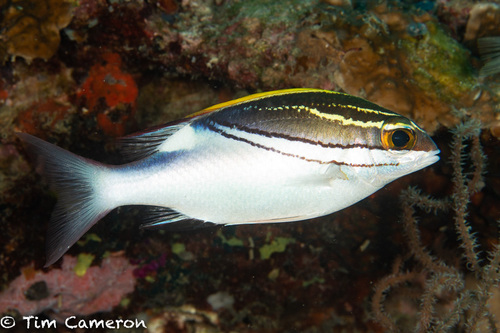
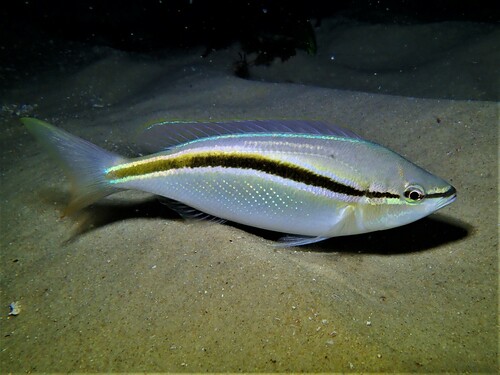
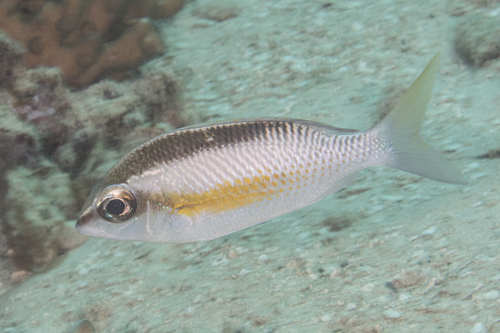
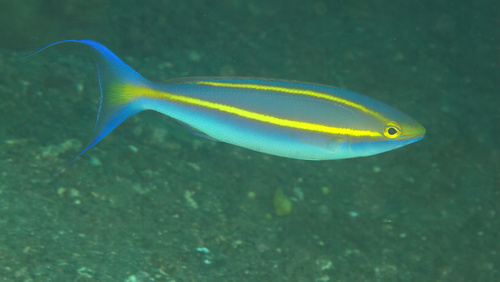
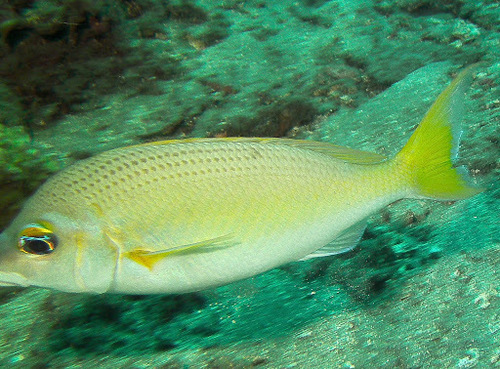
Scolopsis affinis Peters, 1877 has a dorsal fin supported by 10 spines and 7 soft rays, while its anal fin contains 3 spines and 7 soft rays. The depth of its body is approximately one third of its standard length, and the length of its snout matches the diameter of its eye. The scales on its head extend forward to the level of the rear nostrils, and scales are present on the lower limb of the preoperculum. There is no forward-pointing spine on the suborbital. Its pelvic fins are long, reaching at least as far as the level of the anus, and often past it. The caudal fin is forked, and the lobes become falcate in larger individuals. The base body color is silvery-white, with a greyish tint above the lateral line and a wide, longitudinal yellow stripe running down the middle of the body from the eye to the caudal peduncle. The crown and snout are dusky grey, there is a vague bluish intraorbital stripe, and a slender white stripe extending from the center of the upper lip to the eye. The caudal fin is yellow with thin pale blue edges. Juveniles have two longitudinal dusky brown stripes along the back and an additional dusky brown midlateral stripe. This species has a maximum published total length of 24 cm (9.4 in), while 15 cm (5.9 in) standard length is more typical. Scolopsis affinis occurs in the Western Pacific Ocean and marginally in the eastern Indian Ocean, ranging from the southern Andaman Sea east to the Solomon Islands and the reefs of the Timor Sea, north to the Ryukyu Islands of southern Japan, and south to northeastern Australia and New Caledonia. It inhabits depths between 3 and 60 m (9.8 and 196.9 ft), and is found in sheltered areas such as lagoons, on sandy and muddy substrates near reefs.