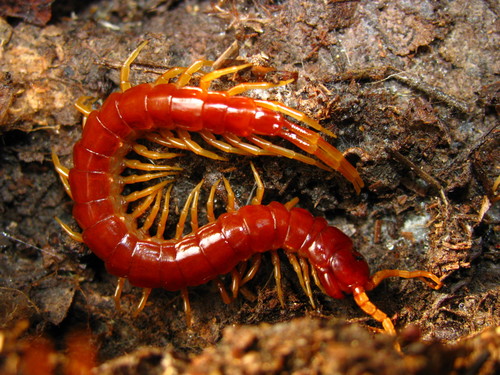
About Scolopocryptops sexspinosus Say, 1821
Scolopocryptops sexspinosus, commonly called the eastern red centipede, is a relatively large centipede that can reach a length of 69 mm. Most individuals are orange or reddish-orange, though specimens from the southeastern portion of its range may be browner in color. Like all members of the family Scolopocryptopidae, this species has 23 leg-bearing segments, with one pair of legs per segment. It has no ocelli, so it is completely blind. Its antennae have very short, dense hairs; the first antenna segment (called an antennomere) is less hairy than the segments further toward the tip. The second trunk segment behind the head is the shortest, followed by the fourth segment, then the sixth segment as the next shortest. The dorsal plates (called tergites) each have a pair of incomplete longitudinal grooves that are restricted to the posterior part of the tergite. The ultimate legs are elongated, and each has two spines near its base: one large, nearly triangular spine on the ventral side of the base, and a second smaller spine on the inner side closer to the middle of the most basal segment of the leg. This species is widespread across eastern North America. Its range extends from Florida and the Gulf Coast north to Ontario, Canada, up the East Coast into New England, and west as far as eastern Texas and Nebraska. It occurs from sea level up to 1,950 m (6,400 ft) above sea level. In Canada, the species is only confirmed from the Niagara Gorge; specimens originally identified as S. sexspinosus from British Columbia were later reclassified as S. spinicaudus. The eastern red centipede lives in a wide variety of habitats, but it typically hides under decaying logs or leaf litter, making it difficult to locate. During the summer, females can be found in rotting wood or under bark, coiled around their brood of eggs or newly hatched young to protect the offspring from predators. This species preys on spiders, insects, earthworms, and smaller centipedes. Adult eastern red centipedes are active year-round, and the species is capable of thermoregulating to maintain its performance across a broad range of temperatures.

