About Scolopendra morsitans Linnaeus, 1758
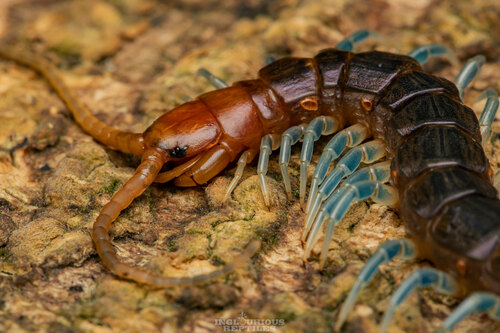
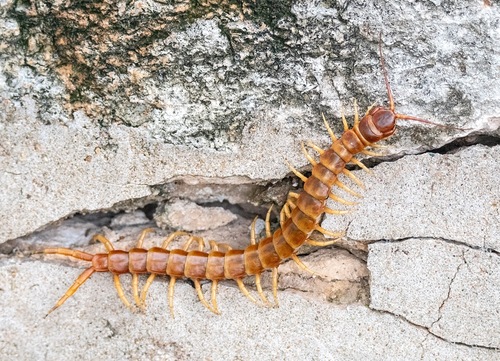
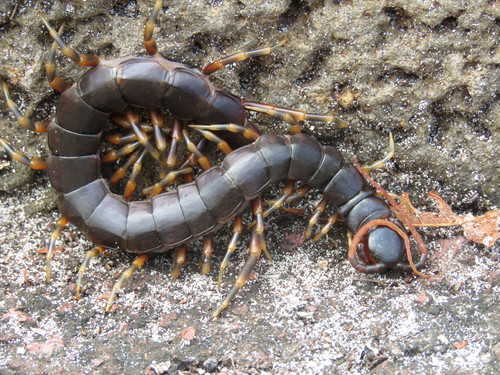
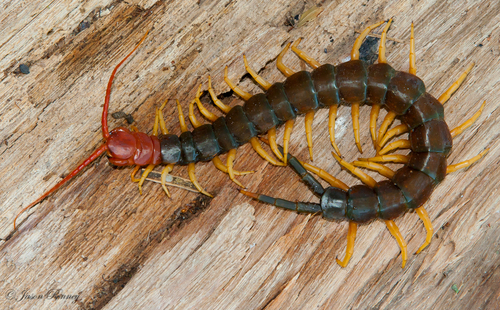
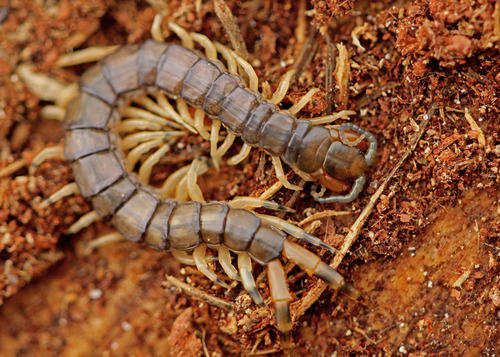
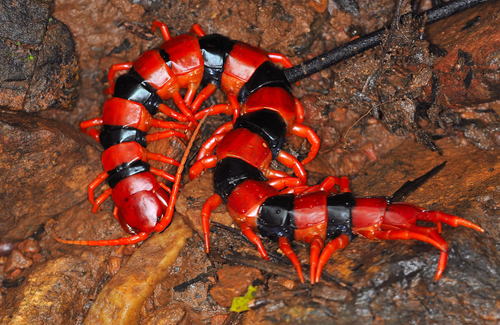
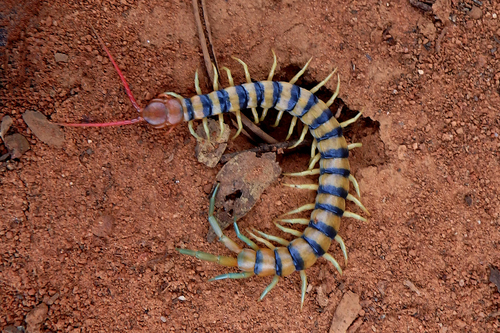
Scolopendra morsitans, commonly called the Tanzanian blue ringleg, has different maximum body lengths across its populations: Australian individuals can grow up to 127 mm (5.0 in), while those from other regions including Southeast Asia rarely exceed 100 mm (3.9 in). Species identification based solely on colour is unreliable, as S. morsitans populations vary greatly in this trait. Still, adult individuals are generally defined by a bright red head, a brownish body with distinct striations between each body segment. Juveniles lack clear stripes, and their head is typically a similar colour to their body trunk. In field observations, this species can sometimes be told apart from other Scolopendra centipedes by its relatively thick ultimate (rear) legs. There are consistent regional colour variations: adult Tanzanian blue ringlegs in north-western Thailand have dark blackish heads and ultimate legs, while populations in north-east Thailand and Cambodia have bright red heads and ultimate legs, and similar colour variation is also seen across Australia and Africa. The antennae of this centipede usually have 18 to 20 segments, occasionally 17 or 21 to 23. The 5 to 7 segments closest to the head have dorsally facing hairs, and the next 5 to 8 segments have ventrally facing hairs. Their tooth plates hold 5 to 6 teeth. Visible paramedian sutures surround the centre of the trunk on body segments 7 to 20, and the centipede's final segment has a central medial suture. This species does not show obvious sexual dimorphism, so subtle differences in the lateral margins of the tergites between males and females are used to visually determine sex. The Tanzanian blue ringleg has a cosmopolitan distribution, found across all major continents, though it has not been widely documented in Europe. It is considered native to most of continental Australia, excluding Victoria, South Australia, and south-western Western Australia; it is also native to most of Africa (excluding the Eritrean Highlands and Red Sea Hills), most of South and Southeast Asia, Madagascar, and Sri Lanka. It has been introduced to much of the Americas, with recorded non-native sightings in Peru, Mexico, Argentina, the Bahamas, and the Southern United States. Researchers have proposed that this centipede's preference for habitats matching conditions on ships has allowed it to widely invade new inhabited areas. The species lives in a diverse range of habitats, from the arid and semi-arid Australian outback to the varied tropical and temperate zones of India and the tropical rainforests of Southeast Asia. Tanzanian blue ringlegs prefer warmer climates, and this preference limits their overall range. They also require sufficient air humidity to survive, which further restricts their habitat selection and distribution. Local geographical populations of this species differ in physical traits, which has led to over 50 scientific synonyms for S. morsitans, most created from misidentification of location-specific populations. Tanzanian blue ringlegs are sometimes kept as pets in captivity, and are traded internationally online for an average price of around US$35. In their life cycle, male centipedes produce sperm-containing packets called spermatophores, wrapped in a silk-like substance, that they deposit into the female's sexual organs. The sexual organs of male and female Tanzanian blue ringlegs are not visually distinct, and examination of an individual's tergites is required to reliably determine sex. Females build brood chambers under substrate in protected locations to hold their young, laying clutches of 22 to 86 eggs. They provide extended parental care by forming a double coil around their eggs, newly hatched instar embryos, and post-embryonic young. When threatened or stressed, guarding mothers may engage in filial cannibalism, consuming their own eggs or embryos to reduce the energetic loss caused by an attack or dangerous situation. Because the Tanzanian blue ringleg shelters under leaves, logs, and other ground substrate, and is primarily active at night, very little is known about the species' natural biology, including specific details about its lifespan or time to maturity. The closely related species Scolopendra subspinipes is known to live an average of over 10 years, while S. morsitans has been reported to live around 4 years in captivity.