About Scolopendra heros Girard, 1853
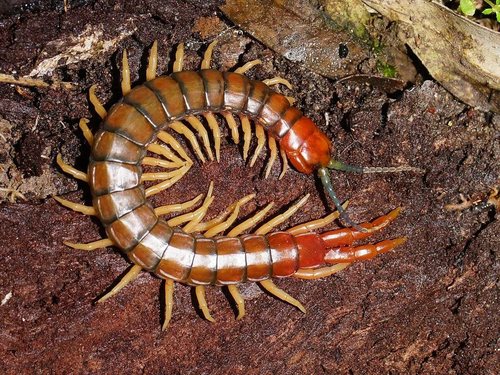
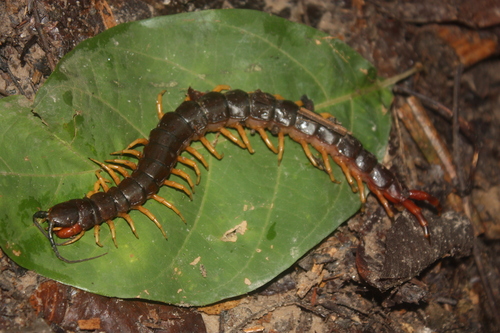
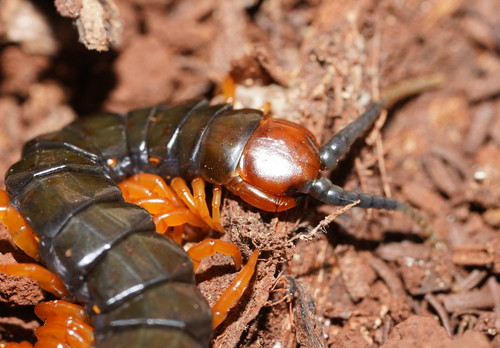
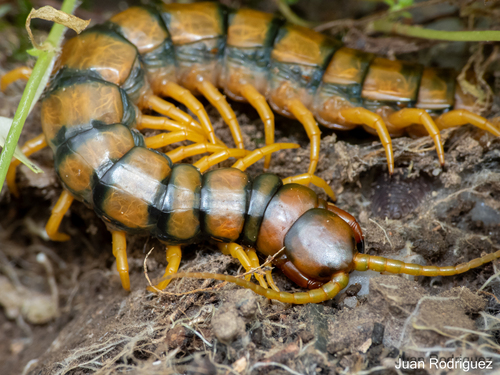
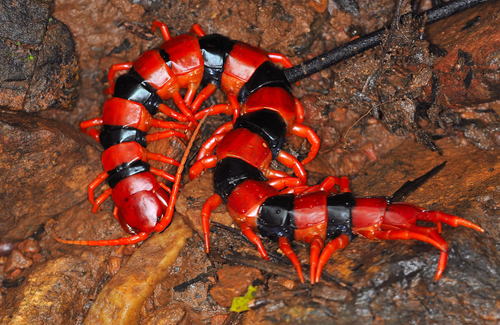
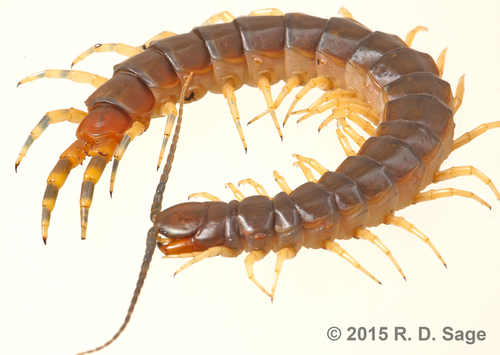
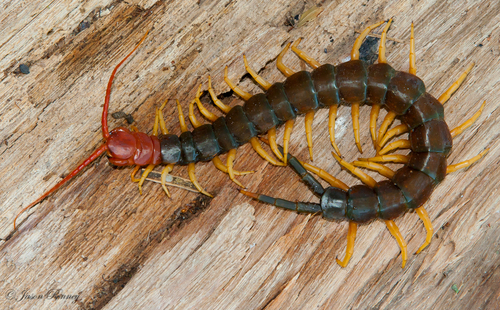
Scolopendra heros is the largest centipede species in North America. It has an average body length of 6.5 inches, or 170 mm. Wild individuals can reach up to 8 inches, or 200 mm, and captive individuals can grow even longer. Its trunk has either 21 or 23 pairs of legs. The species has aposematic coloration, which acts as a warning to potential predators, and multiple distinct color variants are recognized. The castaneiceps variant, found in Arkansas, Missouri, Texas and nearby surrounding areas, is commonly called the "giant redheaded centipede" or "Texas redheaded centipede" due to its characteristic red head and greenish-black body and tail. This centipede is distributed across northern Mexico and the southwestern United States, ranging from New Mexico and Arizona in the west to Arkansas, Missouri, and Louisiana in the east. It is often called the "giant desert centipede" because it lives in the Sonoran and Chihuahuan Deserts as well as other arid and semi-arid habitats, but it can also be found in rocky woodland environments, such as those in Arkansas. S. heros stays underground during warm days, and only emerges when the weather is cloudy. S. heros hatch from eggs. As they grow and mature, they molt and shed their exoskeleton, like all arthropods. Each molt brings them into a new life stage called an instar. Like all scolopendromorph centipedes, S. heros retains the same number of body segments for its entire life. This is a slow-growing species that can live for more than ten years.