About Scolopax rusticola Linnaeus, 1758
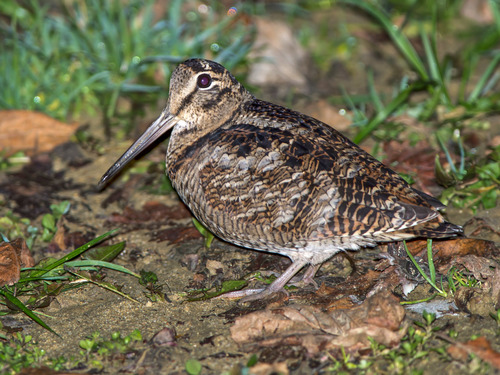
This species, the Eurasian woodcock, has the scientific name Scolopax rusticola Linnaeus, 1758. Adult Eurasian woodcocks measure 33–38 cm (13–15 in) in total length, which includes a 6–8 cm (2.4–3.1 in) long straight bill, and have a wingspan of 55–65 cm (22–26 in). This species has cryptic camouflage adapted to its woodland habitat, with intricately patterned reddish-brown upperparts and buff underparts. Its head is barred with black, rather than striped like the heads of its close relatives, snipes. It has large eyes positioned high on the sides of its head, granting it 360-degree monocular vision. The wings are rounded, the base of the bill is flesh-coloured with a dark tip, and leg colour ranges from grey to pinkish. Eurasian woodcocks are sexually dimorphic: males are much larger than females, but the two sexes cannot be distinguished in the field. Around one third of the world’s Eurasian woodcock population breeds in Europe, and over 90% of the continent’s breeding population lives in Russia and Fennoscandia. The species’ breeding range extends from Fennoscandia to the Mediterranean Sea and Canary Islands, and from western Europe across to Russia. The Azores population is isolated from mainland European populations, leading to subtle genetic differentiation. This woodcock species occurs across most of temperate and subarctic Eurasia. Northern populations migrate to southern Europe, while Asian populations migrate to the Indian subcontinent. Birds in milder western European countries and on Atlantic islands are non-migratory, and populations breeding in north-west and southern Europe are also mostly sedentary. The species’ spring migration begins in February, and birds reach their breeding territories between March and May. While spring migration movements are influenced by weather conditions, this does not have a major impact on subsequent breeding success. Eurasian woodcock has a very large range, with an estimated global Extent of Occurrence of 10 million square kilometres, and an estimated total population of 15 million to 16 million birds. Due to its large range, stable population trend, and large population size, the species has been evaluated as Least Concern on conservation red lists. The most significant threat to Eurasian woodcock populations within their breeding range is increasing fragmentation of their woodland habitat. Outside of the breeding season, reduced area of permanent grassland and increased farming intensification also pose threats, and the species’ susceptibility to avian influenza may impact populations in the future. The breeding habitat required by Eurasian woodcock consists of large, unfragmented areas of broadleaved deciduous forest, or mixed broadleaved and coniferous forest, with dense undergrowth from plants including brambles, holly, hazel, gorse, bracken, and bilberry. At a small scale, Eurasian woodcock appear to prefer woods that contain birch, and are less likely to be found in beech-dominated woods. They also prefer woods located further from urban areas. Breeding territories must contain a mix of dry, warm resting spots, damp areas for feeding, and clearings for flight. In larger woods, wide “rides” (open tracks through the wood) and small clearings are important. In winter, Eurasian woodcock also use scrubland during the day, and may use intertidal mud during freezing weather. Eurasian woodcock forage in soft soil within thickets, typically staying well hidden from view. Their diet consists mainly of earthworms, but also includes insects and their larvae, freshwater molluscs, and some plant seeds. Because they depend on probing into the ground to find food, they are vulnerable during cold winter weather when the ground is frozen. During the cold 1962–63 winter in Britain, starving woodcocks were observed feeding in urban areas, and some were even forced to eat bird seed. They feed nocturnally on frost-free pasture or long-rotation grass meadows. They prefer fields with woodland within 1 km (0.62 mi) to provide space for daytime roosting. Densities of Eurasian woodcock are low in predominantly arable areas. A three-year scientific study in Brittany, France monitored 65 radio-tagged woodcocks to record their habitat preferences. During the day, the birds selected forest areas with humus that supported large earthworm populations and a dense scrub layer for protection; hedges with scrub and trees were also found to be important. At night, woodcocks chose grazed pastures, which held five times the earthworm biomass of tilled land.